
“ICE-Free Zones” Explained: How Cities and Counties are Working Together to Resist ICE
Cities across the country are prohibiting the federal government’s use of city-owned property for immigration enforcement.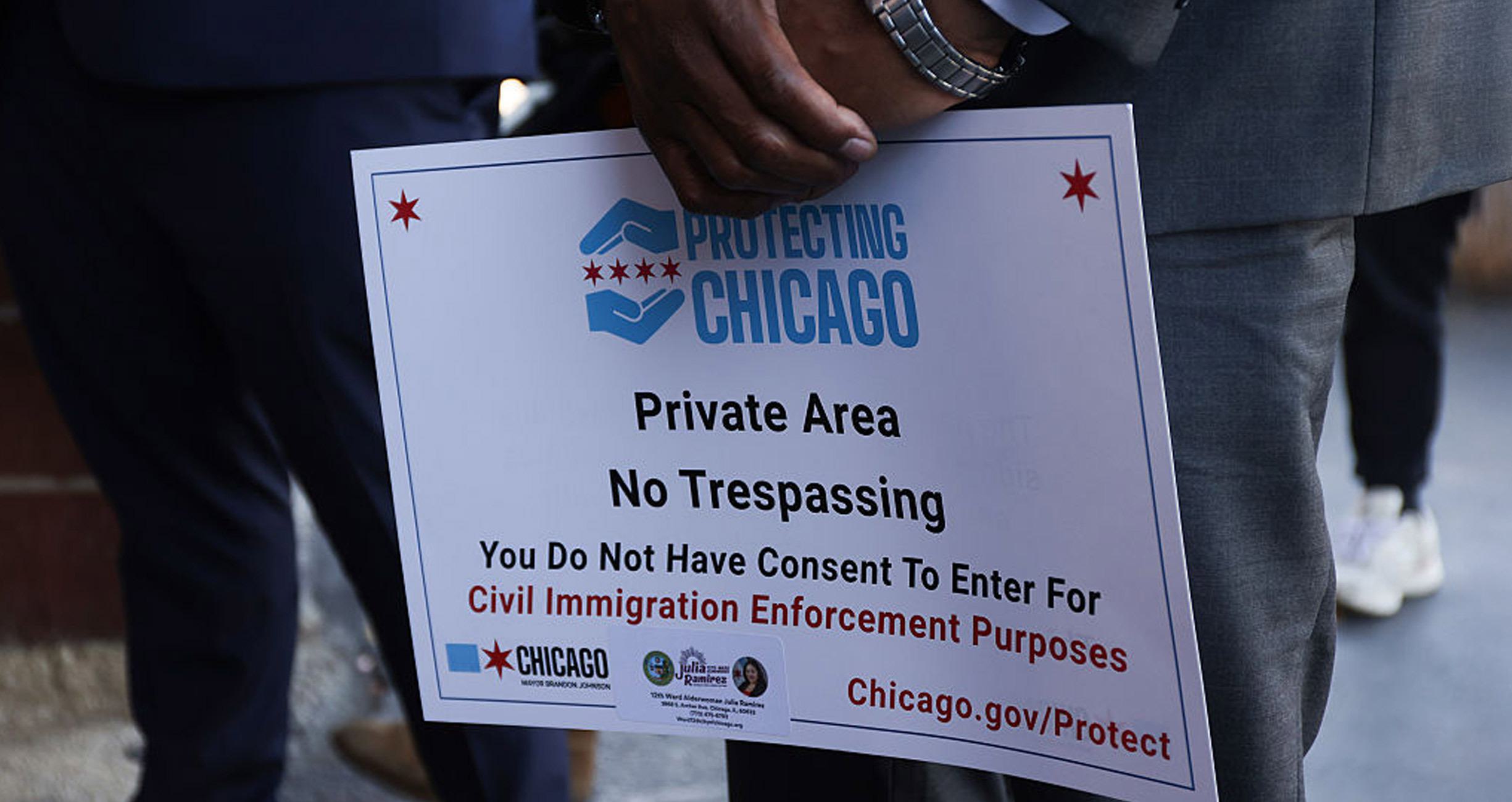
In early December, as the federal government began ramping up immigration enforcement operations in the Twin Cities, Minneapolis Mayor Jacob Frey took a cue from Chicago Mayor Brandon Johnson, who had signed an executive order for what he called an “ICE Free Zone” during Operation Midway Blitz last year. Frey issued a similar executive order—later codified into city ordinance—barring United States Immigration and Customs Enforcement (ICE) and Customs and Border Protection (CBP) from using municipal parking lots, vacant lots, and garages as staging grounds for immigration enforcement. City leaders described the measure as a necessary step to protect the city’s Somali population and reject the administration’s “fear-based tactics.”
Frey’s timing proved apt. Weeks later, thousands of federal agents descended on Minnesota under Operation Metro Surge—the largest immigration enforcement deployment of the second Trump administration—amid large-scale raids, courthouse arrests across the country, and the tragic killings of peaceful protesters Renée Nicole Good and Alex Pretti by federal agents. As these actions unfold in plain view, local officials nationwide are learning from leaders in cities like Minneapolis how to find ways to protect their residents while meaningfully limiting the scope and harms of federal immigration enforcement.
What are ICE-free zones?
A growing number of jurisdictions are responding to out-of-control immigration enforcement by adopting ICE-free zone policies. These are land-use and administrative policies that limit federal agencies from using city- or county-owned property as staging areas, processing sites for arrests, or operational bases for civil immigration enforcement. By doing so, localities can disrupt the infrastructure for large-scale raids, reassert local control over public property, protect residents from enforcement activity, and reinforce trust between immigrant communities and local government.
Given localities’ limited means for resisting federal overreach, these policies have quickly sprung up across the country. In practice, they may be more symbolic than impactful against a supercharged, lawless immigration operation. But even throwing sand in the gears of federal operations matters, as their speed and force have enabled the trampling of due process and other legal protections. Moreover, these policies signal to immigrant communities that the local government is on their side. Alongside other emerging practices—like broader sanctuary policies, investments in deportation defense, and resistance to new detention facilities—they begin to amount to robust opposition.
Crucially, ICE-free zone policies do not prohibit ICE or CBP from making arrests. They expressly avoid interfering with the legal rights of federal law enforcement while clarifying that federal authorities can conduct arrests on city property when supported by a judicial warrant. This framing matters for two reasons. It signals to courts that local governments are not attempting to illegally obstruct federal immigration enforcement. And, more significantly, warrant requirements reinforce lawful enforcement practices. Over the past year, ICE has increasingly relied on so-called “administrative warrants”—signed by ICE officials, not judges—to forcibly enter homes and arrest people despite long-standing Fourth Amendment protections and decades of agency guidance to the contrary. ICE also sometimes makes arrests with no warrant at all. By requiring judicial warrants, ICE-free zones attempt to push ICE back into targeted enforcement, as opposed to roving the streets looking for people to arrest.
Jurisdictions that have passed or are currently pursuing these policies include Alameda County, California; Asheville, North Carolina; Aurora, Illinois; Berkeley and San Jose, California; Chicago; Denver, Colorado; Evanston, Illinois; Los Angeles County and the City of Los Angeles; Minneapolis and Saint Paul, Minnesota; New York City; New Jersey; Oakland, California; Pinole, California; Providence, Rhode Island; San Francisco; Santa Clara County, California; Seattle; Spokane and Everett, Washington; and Worcester, Massachusetts. These jurisdictions recognize that local governments face a choice: allow their infrastructure to be used to exploit and destabilize communities—or set clear limits.
A new tool in the sanctuary policy toolbox
ICE-free zones evolved from long-standing sanctuary policies developed by states and local governments to limit their involvement with federal immigration enforcement. Early sanctuary efforts often took the form of welcoming resolutions or protections allowing people to seek health care, attend school, or call for emergency assistance without fear of arrest and deportation. As federal enforcement strategies evolved, local governments increasingly adopted more concrete rules governing whether—and how—their personnel, data, and property could be used to support immigration enforcement. That shift accelerated after the Obama administration expanded the use of fingerprint-sharing programs that automatically forwarded booking data from local jails to ICE.
Sanctuary protections expanded further during the first Trump administration as immigration enforcement moved into spaces previously treated as off-limits. In 2018, the administration revised long-standing guidance to permit ICE arrests at federal, state, and local courthouses. In response, states including California, Massachusetts,New York, Oregon, and Washington barred civil immigration arrests in and around courthouses absent a judicial warrant. More than 200 cities and counties—and at least a dozen states and Washington, DC—now maintain some form of sanctuary policy.
Even before the term “ICE-free zone” gained traction, some cities used land-use authority to constrain federal immigration activity. In Portland, Oregon, ICE operates out of a privately owned facility subject to a conditional land-use approval that limits detention to 12 hours and prohibits overnight holds. In September 2025, after ICE repeatedly violated those conditions, Portland’s permitting bureau issued a formal land-use violation notice to the property owner, triggering a review that may fine the property owner, force them to correct the harm, or result in a “reconsideration” of how that land is used.
Chicago became the first major city to formally adopt and name an “ICE-free zone” during Operation Midway Blitz last fall—building on sanctuary policies and this property-based approach. Although ICE’s primary processing facility in the region sits on federally owned land outside Chicago, the operation relied heavily on local infrastructure for staging and coordination. Federal agents conducted raids from parking lots, deployed helicopters and armored vehicles, and used crowd-control munitions during arrests and protests—demonstrating how immigration enforcement routinely depends on city-controlled space, whether or not cities authorize that use.
Two case studies for limiting federal use of city property for immigration enforcement
Cities and counties adopting ICE-free zones generally operate within two models. They restrict immigration enforcement on either (1) specified categories of city-owned or -controlled property or (2) any city-owned or -controlled property absent explicit authorization. Jurisdictions also enact the policy through different means, including mayoral executive orders, ordinances, or nonbinding resolutions.
Most cities that have adopted—or are considering—ICE-free zones have chosen to define specific categories of off-limits property and enact the policy through executive order, likely after weighing political, legal, and practical constraints. Executive orders allow mayors to act quickly, avoiding the longer legislative process required to pass a city ordinance. Speed, however, comes with tradeoffs: ordinances are more likely to survive changes in administrations and can cover an entire county.
The following case studies illustrate these two approaches.
Chicago
Mayor Johnson’s October 2025 executive order prohibits the use of city-owned parking lots, garages, and vacant lots for civil immigration enforcement staging, processing, or operations.
The order rests on Chicago’s authority to control its own property and aligns with the city’s longstanding Welcoming City Ordinance, which limits municipal involvement in civil immigration enforcement. Johnson’s order does not attempt to block arrests supported by judicial warrants or restrict enforcement on city property outside the specified categories.
The order instructs city departments to identify properties that have been or could be used for civil immigration enforcement and post signage stating that the space may not be used for that purpose. City employees who observe potential violations are encouraged—but not required—to report them to their supervisor, who will communicate with the city’s mayor and lead attorney. Those reports may be compiled and shared with the Illinois Accountability Commission, a state entity charged with collecting information about federal law-enforcement activity and assessing its impacts. The order also directs the Mayor’s Office to develop signage for private landowners and leaseholders who wish to voluntarily designate nonpublic areas as off-limits for civil immigration enforcement.
Chicago’s groundbreaking, much-emulated order met the urgent needs of the moment. But its practical impact is limited by the lack of an external enforcement mechanism to hold the federal government accountable for violations. Instead, it relies on voluntary reporting and oversight measures aimed at documenting harms rather than compelling compliance. As a result, despite being an important early model, it offers weaker enforcement than newer proposals that seek to impose legal consequences for violations.
San Francisco
San Francisco, which averted a Chicago-like incursion in October, advanced a more aggressive model in December that recently became law. The legislation is a first-of-its-kind binding ordinance that amends Section 4.19 of the city’s administrative code—a longstanding provision governing the use of city property—to explicitly restrict federal immigration enforcement.
Section 4.19, on the books since 1986, requires that city property be used only to advance authorized public purposes. The amendment makes that principle explicit and enforceable in the context of immigration enforcement. It provides that “no person or entity may use” city property without authorization, clarifies that assisting in federal immigration enforcement “is not a City purpose,” and authorizes the city attorney to bring a civil action against any person or entity that uses city property for an “unlawful or unauthorized purpose.”
San Francisco’s ordinance goes further than Chicago’s in many ways. It broadly defines “use” to include licenses, permits, and other forms of authorized access. Further, it seemingly applies to any city-owned or -controlled space, provided it does not conflict with federal law (for example, arrests supported by judicial warrants). Unlike with Chicago’s voluntary compliance, San Francisco’s ordinance prohibits city officials from authorizing uses that would disrupt city operations or discourage access to city services.
Most importantly, San Francisco’s ordinance allows the city attorney to sue violators—including the federal government and even individual ICE agents. By pairing an external enforcement mechanism with an explicit declaration that federal civil immigration enforcement falls outside permissible city purposes, the ordinance carries real consequences—and invites an inevitable legal challenge should it pass.
Are ICE-free zones legal?
Cities and counties have long exercised authority over their own property and day-to-day operations. That authority exists alongside the Constitution’s Supremacy Clause, which makes federal law the “the supreme Law of the Land.” This matters in immigration enforcement: the Supreme Court has long recognized the federal government’s broad authority in this domain.
Two constitutional doctrines define the boundary between these powers: anti-commandeering and intergovernmental immunity. While both have been litigated primarily in cases involving state laws, the same structural limits extend to cities, whose authority is grounded in state law and their constitutions.
Anti-commandeering
The anti-commandeering doctrine, crystallized in Supreme Court decisions since 1992, holds that the federal government may enforce federal law on its own—but may not require states to use their personnel, resources, or property to carry out federal priorities.
This principle has shaped years of litigation over sanctuary policies. Courts have drawn a consistent line: while states (and cities) may not physically obstruct federal officers or prevent lawful arrests, they are not required to honor civil immigration detainers or share certain information about immigration status beyond what federal law mandates. In reviewing the first Trump administration’s challenge to California’s 2017 sanctuary laws, the Ninth Circuit held that even if California’s refusal to cooperate may “frustrate” federal priorities, the Constitution protects a state’s choice “to refrain from assisting with federal efforts.”
Recent litigation over New York’s Protect Our Courts Act (POCA) illustrates this boundary. Enacted in 2020, POCA bars civil immigration arrests in state courthouses. The DOJ challenged the law last June, arguing it violated the Supremacy Clause. A federal district court dismissed the suit, concluding that New York State had not obstructed federal enforcement but instead declined to facilitate it. The DOJ filed an appeal in January. The DOJ is also suing New Jersey over an executive order that goes even further, applying to all nonpublic areas of state property.
The anti-commandeering doctrine is now being tested at the municipal level. In Minnesota, the state and the cities of Minneapolis and Saint Paul challenged Operation Metro Surge, alleging that federal agents repeatedly used city-owned property to stage operations without authorization. The lawsuit references Saint Paul’s long-standing municipal code limiting use of city parking lots absent a permit. As with “ICE-free zones,” the provision restricts unauthorized use of municipal property.
Intergovernmental immunity
While anti-commandeering limits federal coercion of states, intergovernmental immunity operates in the reverse direction, limiting state interference with federal authority.
Under modern Supreme Court doctrine, states may not directly regulate the federal government or discriminate against it. A state law crosses the line if it singles out federal officers or contractors for unfavorable treatment or attempts to control how federal operations are conducted.
The doctrine has been litigated primarily against state laws. In the immigration context, courts have recently drawn clear lines between different types of state restrictions on contracting with ICE. In 2022, the Seventh Circuit upheld Illinois’s statewide ban prohibiting local governments from entering detention agreements with ICE, concluding that the law neither directly regulated nor discriminated against the federal government. One month later, by contrast, the Ninth Circuit struck down California’s attempt to bar private companies from operating immigration detention facilities, reasoning that the law interfered with the federal government’s ability to run detention operations in the manner it chose.
Since then, the Ninth Circuit has applied the same logic to invalidate a King County, Washington, executive order that restricted ICE flights out of the county airport and cut off ICE’s access to private contractors, holding that the county unlawfully regulated the federal government’s method of transporting and deporting people. The precise boundary between permissible noncooperation and impermissible regulation or discrimination continues to be tested in the courts.
Where ICE-free zones fit
While Chicago’s narrower approach may be safer from legal challenges, the broader posture of San Francisco’s ordinance raises more questions. By defining federal civil immigration enforcement as an impermissible use of city property and attaching an enforcement mechanism, the ordinance could be characterized as singling out federal activity for unfavorable treatment. And because it applies across all city property, a court could view it not merely as a refusal to assist but as regulating or discriminating against federal operations.
The distinction is narrow but consequential. Anti-commandeering protects a city’s decision not to provide its resources. Intergovernmental immunity, by contrast, limits a state or city’s ability to directly regulate or discriminate against the federal government. Where courts will draw the outer boundary between these principles remains an open question.
What comes next
Despite Trump’s campaign promises of mass deportation and the excesses of his first administration, the speed and scale of his war on immigrants and blue cities came as a shock to most. But in the second year of this term, jurisdictions are finding their footing, innovating and learning from one another to protect their communities. ICE-free zones are among the most promising steps in this direction and will continue to be refined through new policies and inevitable legal challenges. Still, sanctuary and ICE-free zone policies cannot completely mitigate the harms of Trump’s extreme immigration agenda. It is critical that state and localities couple these policies with public investments into deportation defense, as more than 70 jurisdictions, including 14 states, have already done.
As more jurisdictions continue to pass ICE-free zone policies each week, their importance in both policy and political rhetoric will surely continue to grow. Since day one, the Trump administration has made clear that it intends to “come after” sanctuary jurisdictions by every available means. ICE-free zones—particularly versions that incorporate enforcement mechanisms like San Francisco’s—could become the next flashpoint in this escalating confrontation. The DOJ’s lawsuit against New Jersey’s ICE-free zone policy will be an important case to watch, not least because New Jersey is currently the only state to have enacted such a broad policy statewide.
It remains uncertain whether ICE-free zones will have a significant impact and whether courts will uphold their legality. What is clear is that cities and counties are planting a firm stake in the ground to protect their communities.