
The ICE Killing of Renee Nicole Good is a Watershed Moment for Trump
The latest tragedy in ICE’s long history of violence is speeding up crises already in motion.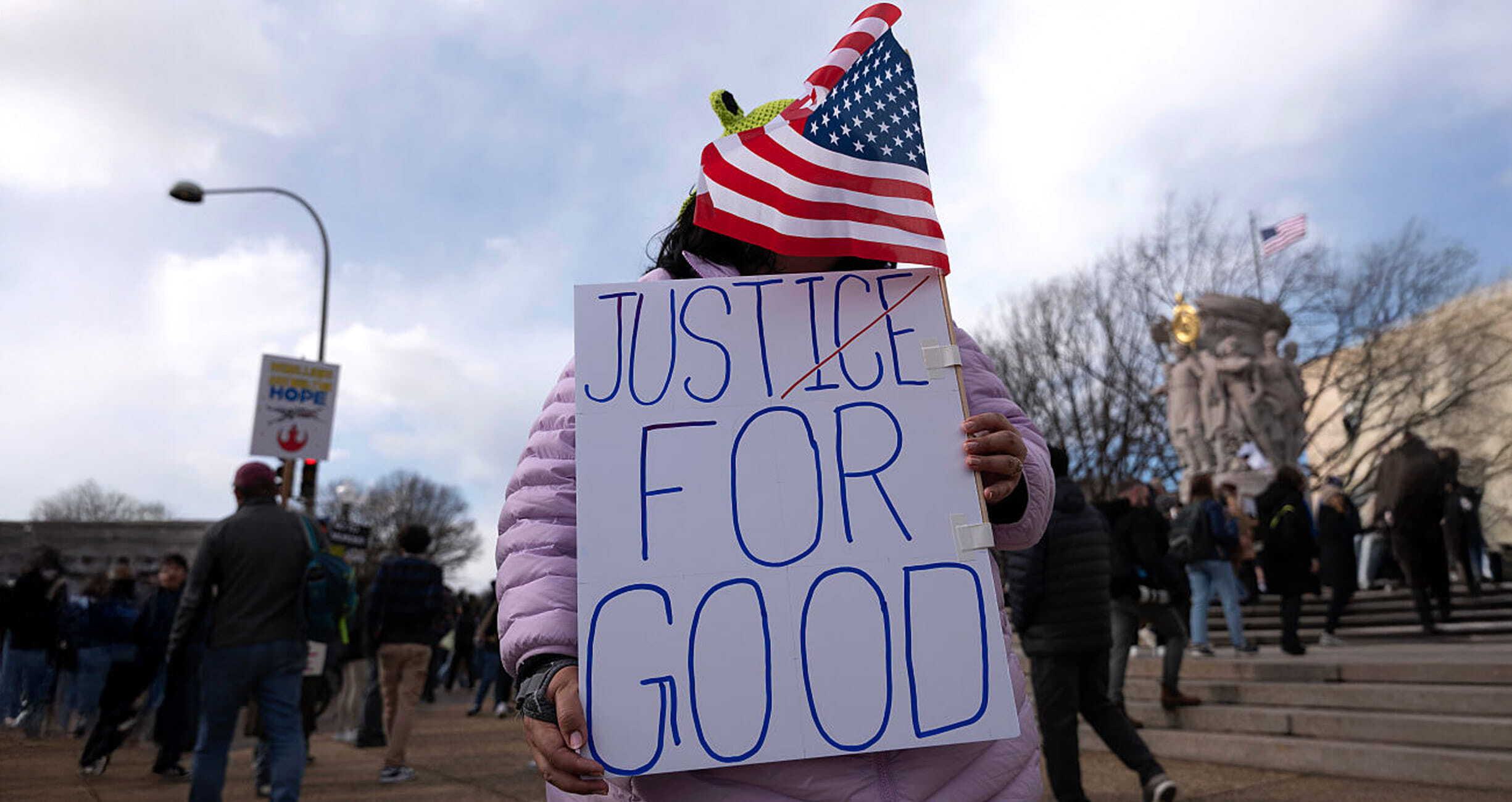
On January 7 in Minneapolis, Immigration and Customs Enforcement (ICE) agent Jonathan Ross opened fire into Renee Nicole Good’s car, killing the 37-year-old mother and United States citizen after she stopped to support her immigrant neighbors—who, since early December, have been in the crosshairs of President Donald Trump’s extreme deportation agenda. As with the murder of George Floyd, also in Minneapolis, video evidence has fueled nationwide outrage over Good’s killing, with more than eight in 10 U.S. voters reportedly having seen the footage.
The administration has thrown its full weight behind ICE, with Trump calling Good “very violent” and “very radical” and Vice President J.D. Vance calling her “brainwashed and a victim of left-wing ideology.” However, a majority of people in the United States disagree—and increasingly disapprove of Trump’s approach to immigration. In a poll released a week after Good’s killing, 53 percent think the shooting was not justified, and only 35 percent said it was.
In just its first year, the second Trump administration has provoked numerous explosive crises. It remains to be seen whether this tragedy will be more tinder for the pile—or the spark that ignites it all.
The latest tragedy in ICE’s long history of violence is speeding up crises already in motion.
Over the past year, ICE’s enforcement operations have been given the political green light to operate with no accountability. Since Trump returned to office, immigration agents have opened fire at least 17 times, killing four people and injuring another eight—though clear data is hard to come by. Video evidence from another shooting in Minneapolis, of Julio Cesar Sosa-Celis, also disputes ICE’s narrative of violent resistance.
For those in ICE custody, 2025 was the deadliest year in more than two decades, with 32 reported deaths—followed by at least four so far in just the first few weeks of 2026—and widespread allegations of torture. The recent death of Geraldo Lunas Campos at a Texas detention facility may be ruled a homicide, as a fellow detainee witnessed guards choking him. By repeatedly lying about these incidents, the administration’s already-minimal credibility continues to plummet—even among its own agents.
In response to ICE’s invasion, mass protests have erupted in Minneapolis and across the country, with a predictably violent reaction from federal agents. There were more than 1,000 events recently as part of the ICE Out For Good Weekend of Action. In response, federal agents—with Trump’s rubber stamp—have battered protesters and community monitoring groups, shooting less-lethal rounds at point-blank range, dragging a woman out of her car, and deploying tear gas from convoys (hospitalizing at least one infant). Last Friday, a district court judge ruled that federal agents in Operation Metro Surge may not use pepper spray or nonlethal projectiles against peaceful protesters, or stop vehicles without cause—a decision the Department of Homeland Security (DHS) has appealed. Minnesota Governor Tim Walz has placed the state’s National Guard on standby “to support local law enforcement and emergency management agencies,” according to the Minnesota Department of Public Safety.
For his part, Trump once again threatened to invoke the Insurrection Act. He quickly walked it back but added, “If I needed it, I’d use it.” To bolster the threat, the Pentagon has made 1,500 U.S. Army troops ready for possible deployment to Minnesota. The 1807 law grants presidents broad authority to deploy federal troops for law enforcement purposes. Trump made the same threat during the 2020 protests after George Floyd’s murder and last year in response to protests against aggressive immigration enforcement operations in Los Angeles, Portland, and Chicago. The Supreme Court’s recent decision limiting Trump’s ability to send the National Guard to Chicago may have also pushed Trump toward the Insurrection Act as a workaround to the Posse Comitatus Act, another law from the 1800s that generally prohibits the military from performing civilian law enforcement. Experts have been skeptical about the constitutionality of such deployments, but legal challenges take time; once boots are on the ground, the damage may already be done.
Channeling outrage and growing demands for accountability, states and localities (and people in the streets) are taking action to rein in ICE.
ICE was created after September 11, 2001, with few mechanisms for accountability, which have only been further weakened in the past year. By the end of 2025, the average number of people in immigration detention daily was 78 percent higher than the year prior. The Trump administration has systematically dismantled the federal watchdog responsible for civil rights violations at DHS and imposed new restrictions on congressional inspections of immigration detention facilities. Meanwhile, Stephen Miller, the key architect of Trump’s cruel immigration agenda, assured ICE agents back in October—including questionable recruits with insufficient training—that they have “federal immunity.”
As the January 30 federal budget deadline looms and Congress prepares to fund DHS beyond its $170 billion windfall from last summer’s One Big Beautiful Bill Act, some congressional Democrats are pushing for more accountability for ICE. Funding for DHS was absent from the House’s most recent spending package, with Democrats pushing for guardrails. Democrats from across the political spectrum are threatening to withhold votes unless the funding package includes basic accountability measures, such as mandatory identification, limiting Customs and Border Protection’s enforcement actions to the border, and mandating judicial warrants to arrest suspects in immigration cases. Congressional Democrats have also introduced a litany of bills to support ICE accountability, like the Federal Law Enforcement Standards and Accountability (FLESA) Act, the Qualified Immunity Abolition Act of 2026, the PUBLIC SAFETY Act, the Stop Body Camera Paywalls Act, and the Stop Excessive Force in Immigration Act—as well as articles of impeachment against DHS Secretary Kristi Noem. While these bills face long odds, they reflect mounting pressure on lawmakers to respond to public outrage over ICE violence.
A small number of Republicans have also signaled openness to minor restrictions, but ones largely focused on optics rather than structural reform. Party leadership remains committed to expanding ICE’s operational freedom, not constraining it. Failing to attach conditions to DHS funding would signal that many lawmakers are willing to legitimize ICE’s escalating use of force despite yet another episode of avoidable ICE violence.
With meaningful oversight—let alone accountability—from Congress unlikely, states and localities are moving to rein in ICE abuses. Along with the Minneapolis protesters’ lawsuit, Minnesota (along with the Twin Cities) and Illinois both filed federal lawsuits seeking injunctions to stop enforcement operations. Meanwhile, Los Angeles County moved to become the latest to institute “ICE-free zones,” which prohibit ICE from operating on county-owned property. New Jersey lawmakers also passed a package of bills to expand protections for immigrants, but outgoing Governor Phil Murphy vetoed it on his last day in office.
With the Trump administration unwilling to do so itself, the question remains whether states can hold immigration agents criminally or civilly accountable. Criminal prosecution faces steep barriers: state and local officials need access to evidence, yet the Department of Justice (DOJ) is both refusing to investigate Good’s killing and also actively blocking access to evidence—forcing Hennepin County Attorney Mary Moriarty to plead for information from the public. Even if Ross is prosecuted, significant legal and evidentiary hurdles will likely constrain charging decisions and the likelihood of conviction.
Civil liability is also available but limited. Good’s family will likely pursue money damages from the federal government through the Federal Tort Claims Act or from Ross as an individual through a so-called “Bivens suit.” But both paths are narrow; federal tort claims are time-consuming and replete with procedural requirements, and the Supreme Court has made it harder in recent years to file Bivens suits against federal agents who violate the Constitution.
In December, Illinois passed a law allowing residents to sue immigration agents in state court for state or federal civil rights violations. Unsurprisingly, the Trump administration quickly sued Illinois—and it remains unclear whether such laws violate the Constitution’s Supremacy Clause. Regardless, states like New York and California are also moving ahead with such laws, with New York Governor Kathy Hochul prominently endorsing the legislation in her most recent State of the State address. And in the meantime, states like California, Illinois, and New York are continuing efforts to document ICE misconduct, whether for transparency alone, future litigation, or eventual prosecution.
Instead of responding to public concern, the Trump administration is closing ranks and escalating.
In a press conference hours after Jonathan Ross killed Renee Good, Secretary Noem suggested that Good was at fault for her own death, claiming she was engaged in “domestic terrorism.” While Trump has finally softened his tone, calling her death a tragedy, he initially said that Good was at fault for trying to “run over” the officer. A week later, the White House issued a press release claiming that mass deportations are responsible for lower housing costs, higher wages, and less crime. The administration’s staunch refusal to acknowledge any wrongdoing by Ross or that ICE’s tactics have grown too extreme is fueling outrage from all corners—even from Tucker Carlson, who faulted Republicans for not acknowledging the tragedy of Good’s death. Trump could have easily lowered tensions by calling the killing an isolated incident and allowing a formal independent investigation to proceed. Instead, the administration is doubling down despite bleeding public support.
The administration is defending its immigration officers in two distinct ways. First, it insists that Ross was acting in self-defense. To prop up that narrative, officials have pushed out a series of stories claiming that Ross was injured during the incident, that he was dragged by a car in June, and that he is a war veteran with extensive military training. At the same time, the administration is also attempting to smear Good as a “domestic terrorist.” The DOJ abandoned its investigation of Ross to instead investigate Good’s wife over her work with a local ICE Watch group, leading six veteran DOJ prosecutors to quit in protest. Second, the administration is asserting that ICE officers have “absolute immunity”—with DHS itself tweeting at immigration officers and urging “decisive action should you be faced with an imminent threat.”
The president is also knowingly escalating the situation. Rather than attempt to calm tensions, Trump sent another 1,000 immigration officers to Minnesota, bringing the total to roughly 3,000. The administration is also ramping up a broader fight with the state, attempting to freeze funding for food stamps and sanctuary cities broadly. The DOJ is also reportedly investigating Minnesota officials, including Attorney General Keith Ellison, Governor Walz, and Minnesota Mayor Jacob Frey. Over all of this looms Trump’s threat to invoke the Insurrection Act and the 1,500 Army troops on standby.
By continuing to weaponize crime and immigration, Trump is betting that fanning the flames of a culture war will protect him in the long run. In the wake of Good’s killing, his approval rating on immigration hit a new low of 38 percent. The administration knows that the polling around ICE and immigration looks bad, but it may be taking solace in the fact that 77 percent of Republicans say Good’s shooting was justified. While igniting fear about crime and disorder is an age-old playbook that Trump has exploited for decades, early signs suggest that it may not work this time. Trump and Republicans will need independent voters in the midterms, but 59 percent believe the shooting was unjustified.
Whether Congress, the courts, or the states are willing to act on that public sentiment remains uncertain. But ICE’s tactics are eroding what little is left of the agency’s political and moral legitimacy. If the administration will not back down, their fates may be tied together.