
Weaponizing the System: One Year of Trump’s Attacks on Due Process
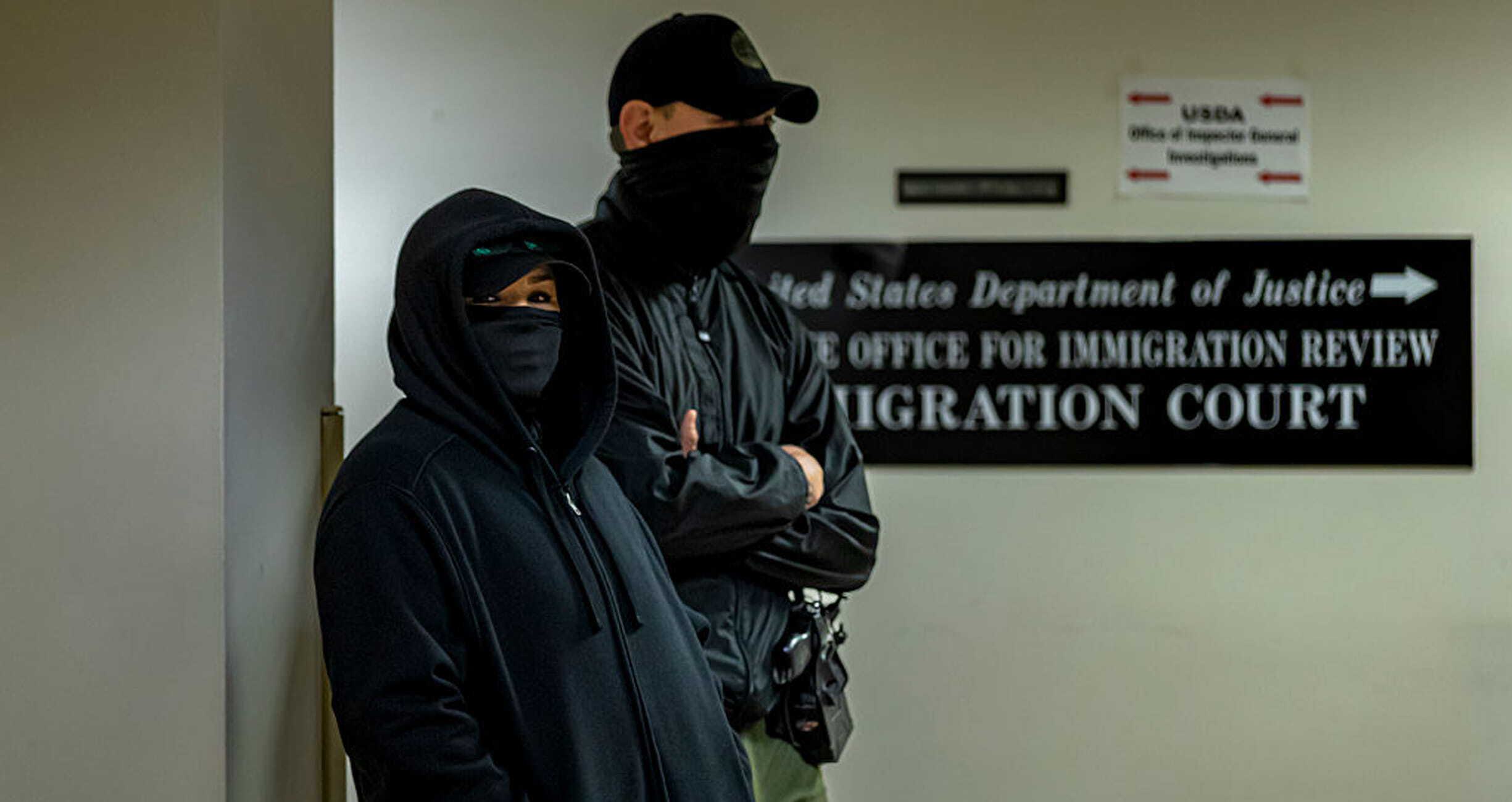
One year into President Trump’s second term, federal immigration policies are systematically dismantling the right to due process. From the early days of his administration, Trump has launched a widespread crackdown on immigrants, enacting a series of policies that have vastly expanded detention, deportation, and enforcement while gutting long-standing protections for due process—the right to fair treatment under the law. Due process is a fundamental right guaranteed to everyone in the United States by the U.S. Constitution and underpins democratic governance. Yet in just one year, Trump has turned the U.S. immigration system into a weaponized force of exclusion, harming community members, sidelining values core to the functioning of a healthy democracy, and posing grave threats to noncitizens and citizens alike.
At the one-year mark of this administration’s efforts to dismantle due process, here are some of the core policy measures that have curtailed immigrants’ rights, separated families, destabilized communities, and undermined our democratic values.
The Trump administration has vastly expanded immigration detention, subjecting hundreds of thousands of people to unnecessary and prolonged detention.
As a presidential candidate in 2024, Trump promised “the largest deportation program” in the country’s history. Since returning to office, he has made good on that promise, making mass deportation a core component of his administration’s agenda. Thanks to Congress’s passage of an unprecedented $170 billion spending package for immigration enforcement and detention, the president has the tools to carry out this cruel promise, including $45 billion explicitly for expanding civil immigration detention.
This colossal allocation of funds—coupled with policies to restrict bond, expand mandatory detention, and use racial profiling as a basis for arrest—has funneled more people into immigration detention than ever before. People in detention experience grave health risks and difficulties accessing essential services, with predictable results; 2025 holds the grim distinction of having the most people die in the custody of U.S. Immigration and Customs Enforcement (ICE) in decades. Even analysis of the government’s own data shows that detention is unnecessary to deter immigration or ensure people show up for their immigration proceedings.
Nevertheless, the administration has widened its net and targeted more and more people for detention, including new mothers appearing at scheduled immigration appointments, foreign students targeted for their speech, and even U.S. citizens. According to an analysis by the Vera Institute of Justice, more than 290,000 people have been detained since the start of Trump’s second term through mid-October 2025, a 19 percent increase compared to the same period the year prior.
Needing the infrastructure to facilitate this mass detention agenda, the administration has co-opted county jails, federal and state prisons, and military bases for immigration purposes. It has also designated Guantanamo Bay as a holding site for deportations, sent people to a notorious prison in El Salvador, and facilitated deportations to third countries where immigrants have no ties, threatening to create legal black holes where U.S. protections—including due process rights—may be impossible to enforce.
Beyond the obvious denial of liberty, these policies treat detention as the default, pressuring people to lose hope, abandon valid legal claims, and accept deportation orders simply to escape indefinite confinement. Those who stay to fight their case face harsh detention conditions and a high likelihood of being transferred to facilities across the country, far from their families and attorneys. Collectively, these efforts make it more difficult to find increasingly limited legal representation, significantly reducing people’s chances of getting a fair day in court.
The Trump administration has turned courthouses and routine immigration appointments into enforcement zones, punishing people for following the law.
People fulfilling their legal obligations by attending hearings and mandated check-ins with ICE are now being targeted for arrest when they appear at what used to be routine immigration appointments. These arrests funnel people actively following the legal process into immigration detention, where they are either quickly deported without the chance to defend their legal rights or forced to continue their immigration case behind bars, away from their families and communities. This undermines due process by punishing people for complying with the law and sends a dangerous message that participation in the legal system carries the risk of detention and deportation—making communities less safe.
VIDEO:
@verainstituteofjustice In 2025, we saw the Trump administration work to systematically dismantle due process in the United States immigration system. Only a couple weeks into 2026, these attacks are intensifying, putting immigrants and their loved ones at immediate risk. These attacks inflict undeniable—often irreversible—harm on immigrant communities. The immigration lawyers tasked with defending their clients’ rights also face immense hurdles. We’re ready for the challenges ahead. Vera will continue fighting for everyone’s fair chance to defend their freedom, and to remain rooted with their families and communities. #Immigration #ImmigrantRights #DidYouKnow #JusticeForAll #UnitedStates ♬ Dark and Aggressive Trap Beat (long version)(1580494) - Koko ni studio
The Trump administration has militarized immigration enforcement, deploying armed forces to occupy U.S. cities and empowering ICE to implement violent tactics.
The administration has falsely and harmfully equated immigration with crime and “invasion” to justify its agenda, including the deployment of more than 35,000 federal troops nationwide, in part to aid ICE operations and quell anti-ICE protests. The deployments, which have often gone against the wishes of the states’ governors, have been met repeatedly with legal challenges and court rulings against the federal government. Aggressively militarized immigration enforcement efforts undermine public safety, community trust, and civil liberties—recently resulting in the tragic killing of a Minnesota woman, Renee Good, by an ICE officer in January. These actions divert resources from state and local governments to vastly expand the federal government’s enforcement apparatus, place millions under military occupation, and erode the constitutionally protected rights of noncitizens and citizens alike.
By conducting massive operations that treat cities as war zones and use the cover of “Kavanaugh stops” to conduct door-to-door enforcement and other stops in immigrant neighborhoods on the basis of “apparent race” and other factors, the administration is manufacturing a crisis to do away with due process rights.
The Trump administration has bypassed immigration courts, denying people the right to fair hearings.
The president and vice president have both decried the existence of immigration courts as barriers to enacting their mass deportation agenda, even going so far as to call immigration court a “fake legal process.”
The administration has sidestepped the courts and the ability of people to defend their rights wherever it can. It has dramatically expanded the use of “expedited removal,” a process that authorizes immigration officers to deport people who meet certain (and rapidly multiplying) criteria without a hearing. This fast-tracked process makes it nearly impossible for people to consult with counsel, present evidence, or otherwise contest the case being made against them before a judge—all essential components of due process.
Without access to the courts, there are few safeguards preventing the government from permanently expelling anyone deemed undesirable, noncitizens and citizens alike. The result has been wrongful deportations of people with valid legal claims, including asylum seekers fleeing persecution and long-term residents with deep family and community ties. By stripping away access to the courts, this policy dismantles one of the most fundamental protections of due process: the right to a fair and just hearing.
The Trump administration has weaponized the courts and undermined judicial independence to new extremes.
An essential component of due process is the ability not only to have one’s case heard before a judge, but to have an impartial judge. Immigration courts, however, have never been independent judicial bodies, as they are administered not by the judicial branch but by the executive. As a component of the U.S. Department of Justice, they are overseen by the attorney general—who is appointed by and executes the policies of the president.
This fact, which has long hindered the impartiality of the immigration legal system, has been fully exploited by this administration. Despite more than 3 million currently pending cases, the administration has fired more than 100 experienced immigration judges, many of whom have backgrounds in immigration legal defense, and eliminated nearly half of the body responsible for reviewing appeals. Attorney General Pam Bondi, using her authority to refer cases to herself due to the courts’ position in the executive branch, has further vacated judges’ decisions with which she disagrees.
To fill the gap created by their own firings, the administration has loosened the requirements and training needed to be an immigration judge. The government is also turning to unqualified military lawyers without any experience in immigration law to serve as what have been referred to as “deportation judges.” Immigration law is notoriously complex; it is unfathomable that someone without experience and little training would preside over cases that can often mean the difference between life and death. These unprecedented moves weaponize what should be an impartial judiciary and instead seek to make it a component of the immigration enforcement apparatus.
The Trump administration has sought to eliminate federal funding for legal access and representation programs for people facing deportation.
Unlike in the criminal justice system, there is no right to government-appointed representation in immigration court for people who cannot afford to hire an attorney. Yet it is nearly impossible for someone to understand the complexity of immigration law without a lawyer. Research consistently indicates that immigrants represented by a lawyer are significantly more likely to successfully defend against deportation and obtain legal relief. People in detention face even more challenging circumstances, with limited access to a small pool of volunteer attorneys and difficulty obtaining evidence to use in their defense from within the confines of detention.
Over the past year, the Trump administration has slashed federal funding to help people access legal information and representation. It has sought to eliminate funding for virtually all immigrant legal service programs, including those for children and people with mental health disorders unable to represent themselves. While cuts to some programs, like the Unaccompanied Children Program and the National Qualified Representation Program, have been paused while litigation is pending, the administration has continued its attempts to undermine their efficacy and independence through other actions. These efforts leave millions of immigrants, including children, asylum seekers, and families, without meaningful access to counsel.
Without the support of an attorney, people of all ages face a system drastically stacked against them, forced to argue their case alone against a trained government lawyer—a massive undermining of the fairness of immigration proceedings.
By the Numbers: Attacks on Due Process in 2025
The Trump administration has threatened citizenship and revoked legal status from people in the country lawfully—subjecting more people to detention and deportation in a system increasingly devoid of due process.
The administration is seeking to curtail the very act of immigration itself by limiting legal immigration pathways—both preventing the arrival of newcomers and stripping people lawfully in the country of status. The administration has stripped visa holders of their legal status for political speech with which they disagree, revoked temporary protected status from migrants from certain countries, and reduced refugee admissions to historic lows—with priority given to white South Africans. And in November 2025, the administration announced it would halt all asylum decisions, placing thousands in legal limbo. It has even planned to denaturalize certain U.S. citizens—setting a quota of up to 200 people per month in 2026—and sought to eliminate constitutionally protected birthright citizenship.
These actions actively criminalize people who are fleeing violence in their home countries and push them into increasingly dangerous and desperate situations. But immigrants are central to our culture, our families, our economy, and our communities in the United States. Welcoming newcomers and providing ample legal pathways to citizenship, security, and stability promotes our collective well-being and prosperity. Americans agree: polling shows that a record-high 79 percent consider immigration to be good for the country.
Yet the administration is acting against public sentiment and is instead attacking both noncitizens and citizens—whose legal status and citizenship were thought to be inviolable—vastly expanding the number of people who can be targeted by its dangerous detention and deportation enforcement tactics.
The bottom line: due process is essential to our democracy and cannot be taken for granted.
Despite these attacks, people across the political spectrum in the United States are increasingly opposing the Trump administration’s immigration enforcement and mass detention efforts.
More than 100 lawsuits have been filed against the administration for its immigration policies. Federal courts have already reaffirmed the right to bond hearings for many people facing deportation; challenged the government’s position that it can indefinitely detain people it seeks to deport to a third country; and rejected the use of detention in retaliation for exercising constitutionally protected speech. They have further upheld New York State’s ban on warrantless arrests in state and local courts and barred warrantless arrests in Chicago and Washington, DC, absent a demonstration of probable cause. Many more cases remain pending. Members of Congress have also introduced legislation to protect people appearing for routine legal hearings and appointments in immigration court. Despite these wins, litigation will continue to be dynamic, with appeals and new filings certain to continue to impact the rights and legal options of people at risk of deportation for as long as the administration pushes its hardline agenda.
In addition, local and state governments are supporting community members targeted by the administration. According to the Vera Institute of Justice, in the past year, jurisdictions like Massachusetts, California, Baltimore, and nearly 30 others—including many of those in Vera’s Safety & Fairness for Everyone (SAFE) Network—have stepped up to increase or initiate legal defense funds for immigrants. They join the more than 70 jurisdictions nationwide that have invested in deportation defense programs since 2014 to keep families together, stabilize communities, and safeguard due process. Yet with millions still facing deportation alone without the support of legal counsel under incredibly challenging circumstances, more must be urgently done.
The right to due process and fair treatment under the law is guaranteed by the U.S. Constitution to all people in the United States, regardless of where they were born. The systematic erosion of these rights poses grave threats to the safety of immigrant community members and to everyone in the United States. As the Trump administration acts to dismantle a basic tenet of our democracy, leaders at all levels of government and community members alike must continue to push back to safeguard our democracy and advance immigration policies that respect fairness, family unity, and human dignity.