
Supreme Court Delivers Devastating Blow to Immigrant Families in Temporary Protected Status Decision. Now Congress Must Provide Lasting Security.
By allowing the Trump administration to end protections for people from Haiti and Syria, the Supreme Court exposed more than a million TPS holders to deportation. Congress should now create lasting pathways to legal residency.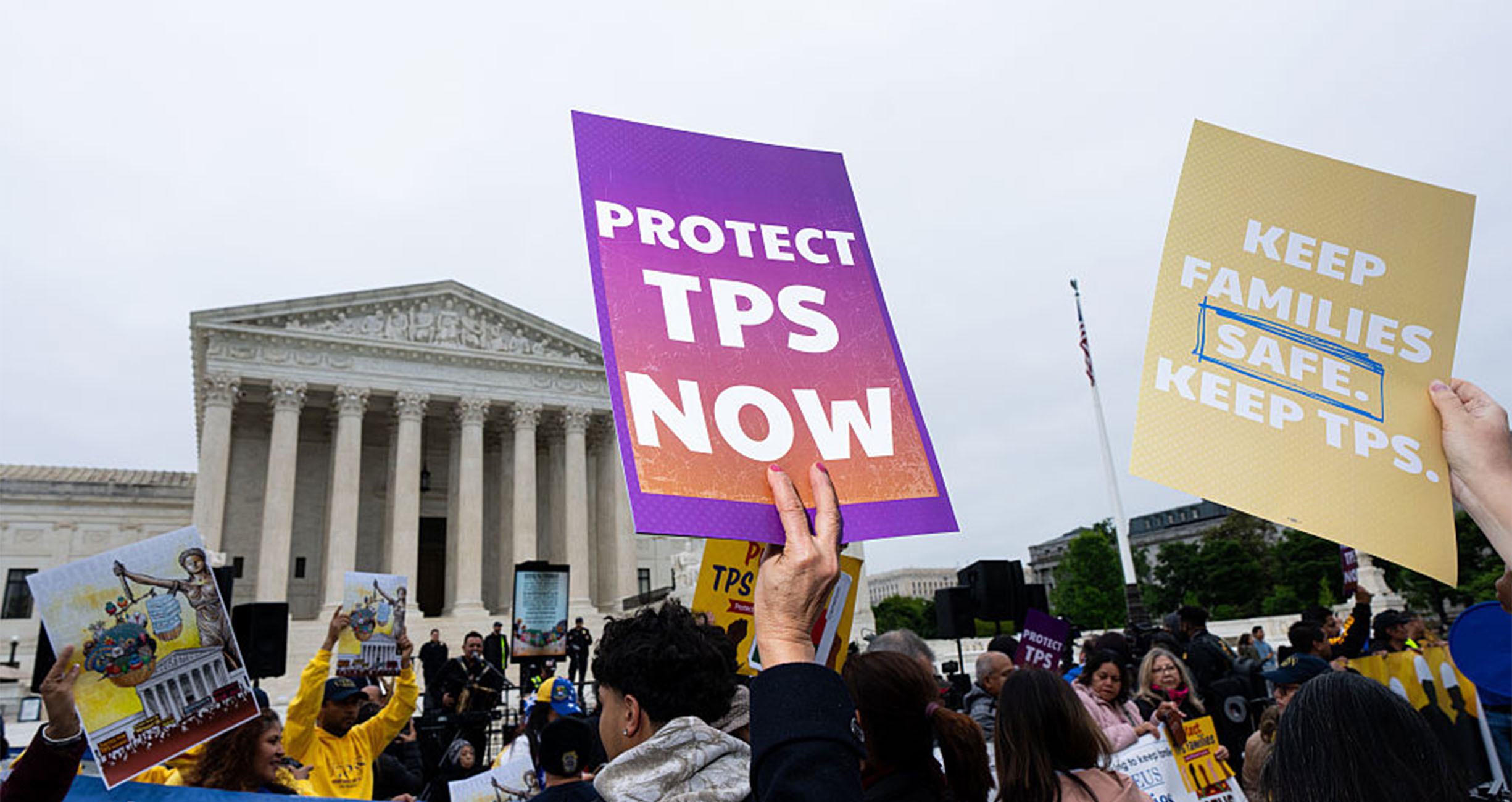
Today, the United States Supreme Court dealt a devastating blow to hundreds of thousands of immigrant families by ruling that Haitians and Syrians are not protected from deportation while the litigation challenging the Trump administration’s termination of Temporary Protected Status (TPS) unfolds. The Court also found that the plaintiffs were unlikely to prevail on their underlying constitutional claims. As a result, people who built lives, careers, and families in the United States can be ripped from their communities, funneled into an ever-expanding network of immigration prisons, and deported to unsafe countries.
Congress should immediately create lasting pathways to legal residency for TPS holders and others who have established deep roots in this country. Immigrants should not continue to face fear and instability in a constantly shifting landscape of immigration policy and regulations. Beyond the immediate harm this ruling will cause, it also underscores a troubling reality: too many immigrants in the United States remained trapped in temporary statuses that can be revoked at the whim of political leaders. The Supreme Court’s ruling also emboldens President Donald Trump’s agenda to end protections for all 1.3 million TPS holders from other countries.
People who have spent years contributing to their communities should not have to live in fear that a change in administration will separate them from their families and livelihoods.
Returning people to Haiti and Syria will subject them to unnecessary danger and is part of the Trump administration’s broader xenophobic effort to strip lawful status from immigrants in this country. In addition to terminating TPS designations for people from more than a dozen countries, the Trump administration has attacked parole for immigrants and initiated unprecedented efforts to denaturalize citizens who have received U.S. citizenship. The removal of TPS is clearly an attempt to expand the number of people who are at risk of being separated from their families, placed in squalid inhumane detention camps, and returned to countries where they face danger.
What is TPS? The Temporary Protected Status program at the heart of the Supreme Court’s decision allows the Department of Homeland Security to provide legal status to citizens of countries that are unsafe due to natural disasters, armed conflict, or other “extraordinary and temporary” conditions.
Citizens of Haiti became eligible for TPS after the 2010 earthquake devastated the country, killing more than 300,000 people and destroying critical infrastructure. Syria received TPS designation in 2012 in the wake of a “brutal crackdown” by Syrian dictator Bashar al-Assad against anti-government dissenters.
The initial TPS designations of Haiti and Syria lasted for 18 months but were repeatedly extended because conditions in both countries remain exceptionally dangerous. Around 330,000 Haitians and nearly 4,000 Syrians had been living in the United States under TPS protection when, in 2025, Kristi Noem—then the Secretary of Homeland Security—announced that the Trump administration planned to end TPS designations for both countries.
President Trump’s abrupt and arbitrary removal of TPS from Haiti and Syria was not based on analysis of the safety conditions in either country. Indeed, the U.S. Department of State website notes that U.S. commercial flights are not operating to or from Port-au-Prince due to ongoing instability and widespread violence. It also advises Americans to “not travel to Syria for any reason” and states that “no part of Syria is safe from violence.” Yet, after lengthy court battles, the Supreme Court has now found that terminations to TPS designations, like Haiti and Syria, are largely shielded from judicial review and scrutiny, even when statutorily-required procedures are not followed.
As a result of this ruling, more than 330,000 Haitians and Syrians are at risk of being separated from their families and swept into the Trump administration’s ever-expanding system of inhumane immigration prisons. This will cause chaos in our communities as people who have lived in the United States for more than a decade are ripped from their homes, families, and the workforce, where many fill vital health care roles.
The Supreme Court may have allowed the Trump administration to end TPS protections, but state and federal governments are not powerless to act. As countless community members now face the threat of prolonged detention, deportation, and family separation, lawmakers at every level should expand funding for immigration legal services so that those affected have a meaningful opportunity to defend themselves and can explore other avenues for remaining with their families and communities.
But legal assistance alone cannot solve the underlying problem. “With so many people now in danger of being deported, the need for meaningful pathways to legal status that provide stability instead of chaos is critical,” said Insha Rahman, president and director of the Vera Institute of Justice. “Congress must act.”