
Series: Dispatches from Germany
Rooting Reform in History
A Dispatch from the Global Justice Exchange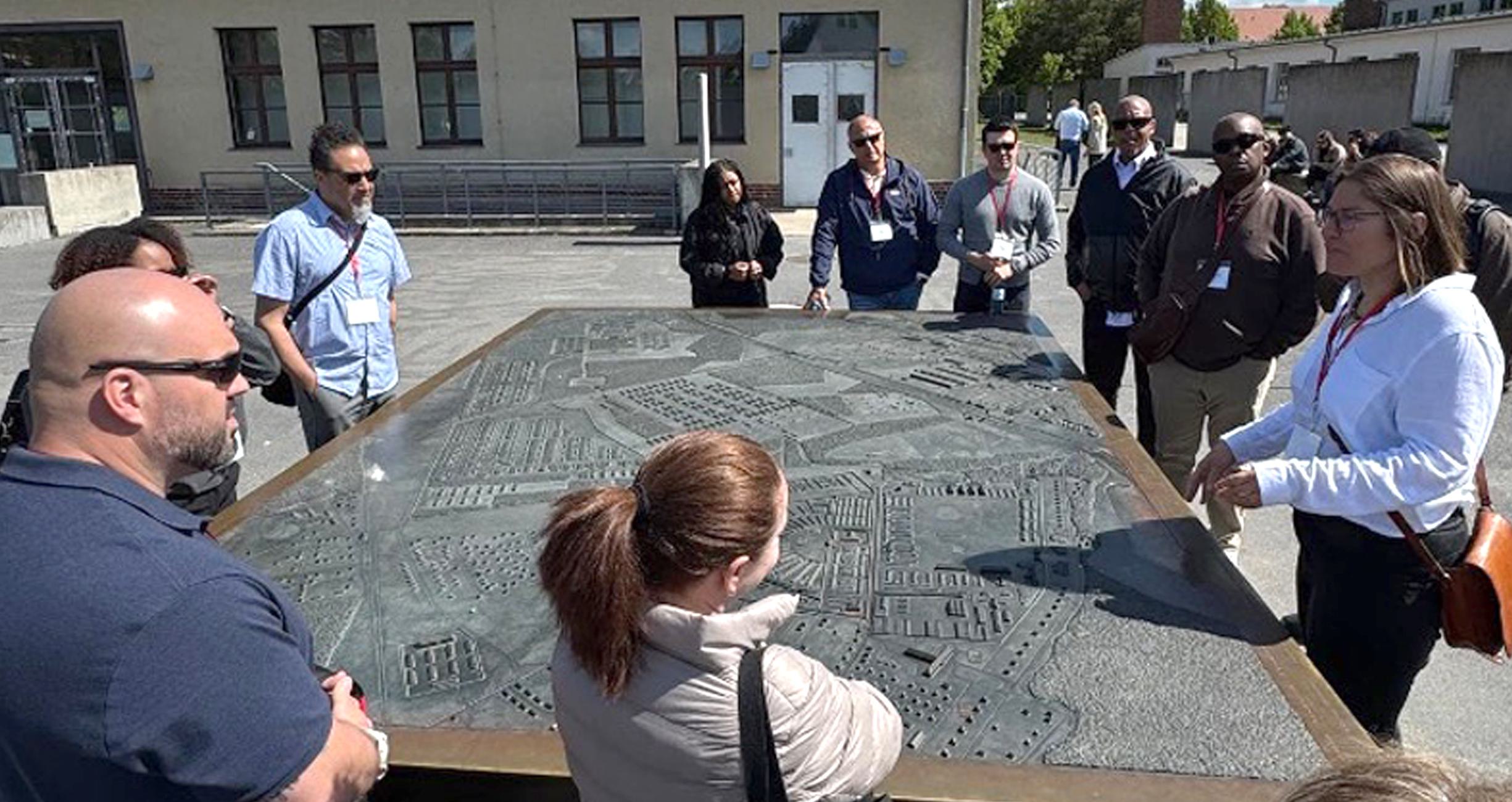
Sarah Rehberg provides an overview of the grounds before leading a tour of the Sachsenhausen concentration camp and memorial
Since 2013, the Vera Institute of Justice (Vera) has organized high-level study delegations composed of diverse justice practitioners and leaders to visit Germany—where the conditions of incarceration are designed to promote safety and dignity. The goal of the tour is to stimulate breakthrough thinking and ambitious criminal justice reform here in the United States by learning about the German system’s operations, underpinnings, and philosophy. This year's delegation included Daniel Martuscello, commissioner, and Robert Mitchell, assistant commissioner for correctional facilities from the New York State Department of Corrections and Community Supervision; Stanley Richards, commissioner of the New York City Department of Correction; and Nicholas Deml, remediation manager for Rikers Island. The dispatches include Vera staff observations from visits to several German prisons.
“Human dignity shall be inviolable. To respect and protect it shall be the duty of all state authority.” —Article 1 of the Grundgesetz, the constitution of the Federal Republic of Germany
This May, Vera led a delegation abroad as part of our Global Justice Exchange initiative. The initiative brings together corrections leaders, advocates, and supporters to learn from one another, get inspired, and imagine bold, ambitious change back in the United States. On this trip, we have been particularly mindful of what lessons we can take back with us to New York—with officials from New York State and New York City in attendance.
With new leadership in place, New York has a unique opportunity to garner support to bring more dignity to the people incarcerated in its systems and the staff working there. New York City Department of Correction Commissioner Stanley Richards inherited a system of 7,000 people and is facing a staffing and conditions crisis. New York State DOCCS Commissioner Daniel Martuscello is leading a system that has been left in a precarious position after last year when two incarcerated people were killed by corrections officers and there was a months-long strike by staff. Both leaders have a choice of how to move forward and it is encouraging that they chose to join the Global Justice Exchange.
We were in Germany, a special place for us. Germany was part of our first Global Justice Exchange in 2013 and deeply influenced the approach taken to create Vera’s Restoring Promise initiative’s young adult housing units, which center dignity in all aspects of prison culture. There are many countries like Germany that do not over incarcerate the way the United States does and that organize prison life around human dignity. But we keep coming back to Germany often because their commitment to human dignity for people in prison is an outgrowth of reckoning with their past.
This is why we started our week of learning—which included tours of courts, jails, and prisons—rooting ourselves in history. Our guide Sarah Rehberg led the Vera delegation on a tour of the Sachsenhausen concentration camp and memorial. As we walked through the gates of the camp, inscribed with the words “arbeit macht frei,” which translates to “work sets you free,” we felt the weight and heaviness of the solemn ground where so many were worked, by design, to their death. We learned that upon entering the camp, the imprisoned were stripped of their personal belongings, issued a number and uniform, and had their heads shaved. They were then classified according to their “crime”—whether it was political dissent or “asocial” behavior or religion or race or culture. They were also studied. For example, the Nazi regime evaluated how long it took for someone to die in the work camp depending on the work they were forced to do.
As the delegation listened, we heard echoes of these atrocities in the design of prison systems and the treatment of incarcerated people in the United States. We reflected on the parallels; the choices and decisions made in creating systems that dehumanize people and justify horrible treatment of them. At the end of the tour, Commissioner Richards reflected, “learning this history is powerful because it shows clearly that demonizing people allows for the justification of inhumane treatment.”
After the atrocities of the Holocaust, the German people accepted a new constitution with the very first article asserting the inviolability of human dignity. The heads of the prison system, as a state authority, are bound to respect and protect human dignity—the constitution's first article makes it clear it is their duty. Reckoning with their history shaped the prison system we came here to better understand and learn from. Commissioner Martuscello came away stronger in his commitment to centering people: “It is my responsibility to ensure, regardless of whether you work or are incarcerated in the system, that you are respected as a person first.”
Over the course of the week, we learned how they operationalize their duty to protect human dignity. We learned how people in prison continue to advocate for more rights and better protections.