
Series: Dispatches from Germany
Organizing Prisons Around Human Dignity
A Dispatch from the Global Justice Exchange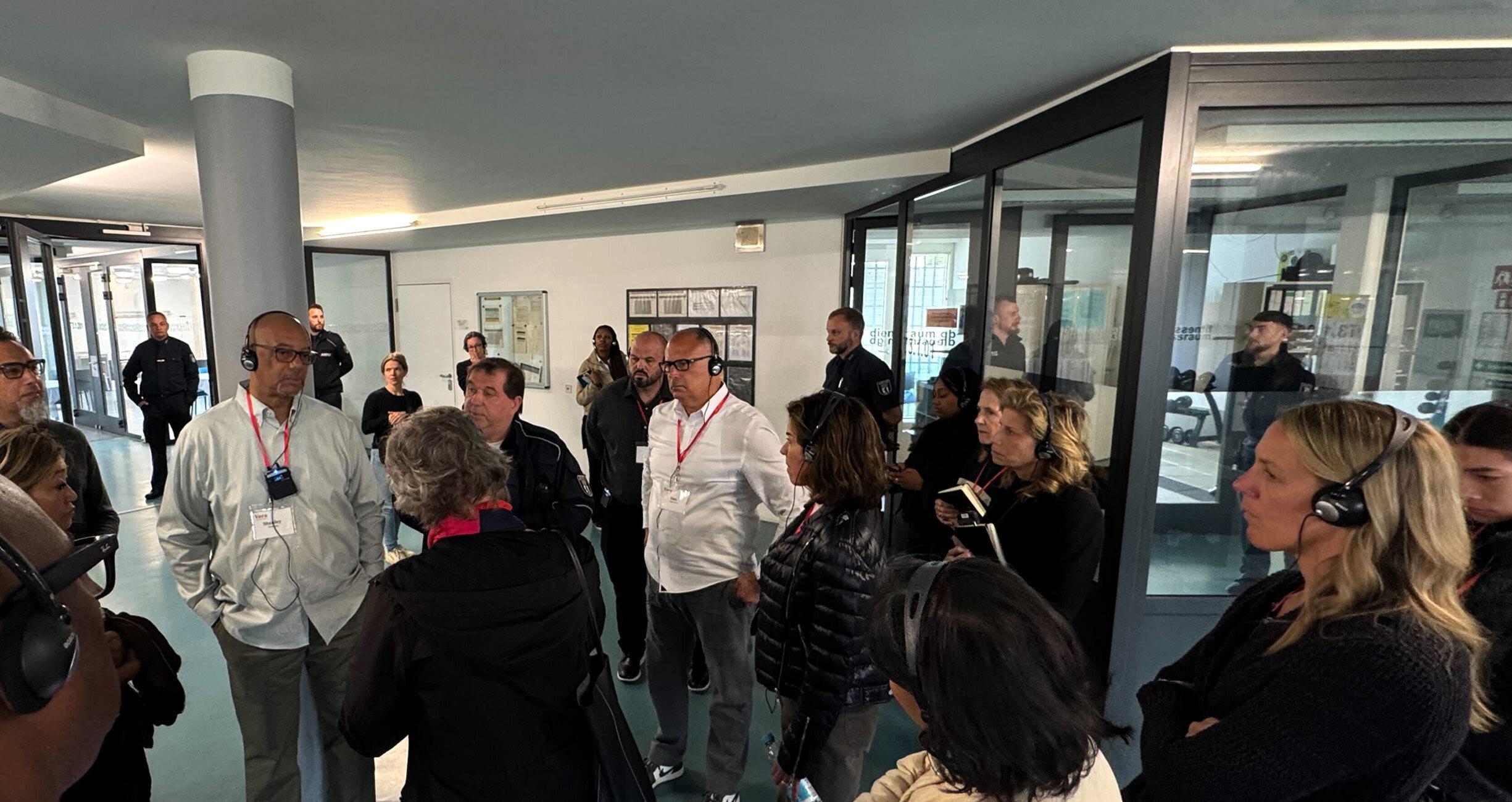
Delegation members, including Stanley Richards and Dan Martuscello, tour Heidering Prison, Berlin’s newest correctional facility.
Since 2013, the Vera Institute of Justice (Vera) has organized high-level study delegations composed of diverse justice practitioners and leaders to visit Germany—where the conditions of incarceration are designed to promote safety and dignity. The goal of this tour is to stimulate breakthrough thinking and ambitious criminal justice reform here in the United States by learning about the German system’s operations, underpinnings, and philosophy. This year's delegation includes Daniel Martuscello, commissioner, and Robert Mitchell, assistant commissioner for correctional facilities from the New York State Department of Corrections and Community Supervision (DOCCS); Stanley Richards, commissioner of the New York City Department of Correction; and Nicholas Deml, remediation manager for Rikers Island. The dispatches include Vera staff observations from visits to several German prisons.
In our previous post, we shared how Germany’s reckoning with history shaped and molded their approach to incarceration and the responsibility of the state to continue to treat people with dignity when the decision has been made to incarcerate someone (which, they only do in about 4 percent of people who are convicted of a crime). After the Global Justice Exchange delegation rooted ourselves in history, we turned our attention to understanding how Germany operationalizes that approach and responsibility. We visited four prisons in four days, observed court proceedings, and spent time with Berlin's leaders at the Ministry of Justice (their version of a state’s department of correction).
The prisons we toured ran the spectrum from old to new—some with buildings built one hundred years ago and others designed a decade ago.
First, Vera brought the delegation to meet staff and young people at a juvenile prison, Jugendstrafanstalt Berlin. People up to 27 years old can be housed there and the space feels like walking on a college campus. We met young people—eager to know if U.S. prisons were really like what they saw on television. They talked about the positive relationship they have with staff that help keep everyone safe. One young person told us, “They always make sure we have what we need. We may disagree sometimes, but we are always able to talk through things with the officers.”
We then visited a minimum-security prison, Hakenfelde, which operates as what Germany calls an “open prison.” The goal of placing someone in an open prison is to provide them with a supportive environment (housing, employment, social services) without tearing them away from their family and community. Incarcerated people in this system go to jobs every day, and they can visit their families daily or over the weekend. In fact, many people in the open prison only return at night. Minimum security carceral settings, with day or even weekend furlough programs are not unheard of in the United States, but the scale of the system in Berlin is what impresses: upwards of 30 percent of the people incarcerated in their system are in the open prison system.
Our third visit was to Berlin’s most modern prison, Heidering Prison, where the warden led us through his theory that the architecture of a building can shape the culture inside. That is why the newest prison design was designed to ensure the well-being of everyone—whether they are incarcerated or work there. For staff, we saw spaces with both indoor and outdoor access built into each housing units’ control room so they can take breaks or get a breath of fresh air. We spoke with staff about how their management protects a work/life balance, with routine schedules and no mandated overtime. They all reported feeling safe and described a sense of purpose in helping people through their role—a position they felt prepared for through the two years of training they received in psychology, social work, history, law, and security.
We then toured a prison and jail—Tegel and Moabit—that were built in the late 1800s. The Berlin system struggles with how to operate these older buildings under modern prison law. We were able to see small innovations, like providing people with shower curtains to separate their bed from their toilet. At one point, we smelled smoke and Warden Martin Riemer clarified, “Oh yes, people can smoke in their rooms. That is their home, for the time being.” We met the editors of the prison magazine, Der Lichtblick or Ray of Hope, the completely uncensored magazine published four times a year by those incarcerated there and learned that their publication has all the same freedoms of the press as any outside news outlet.
At every stop on our tour, unprovoked, an employee or leader would inevitably reconnect us to history. In their efforts to help us understand why they do something a certain way, the answer always was rooted in the lessons they took away from the horrors of the Holocaust. At every location, whether old or new, the culture was consistent—with staff at every level understanding their work as an act of service, a way to help people. Richard Buery—a member of our delegation and CEO of Robin Hood, a leading anti-poverty organization—observed, “Berlin shows what's possible when the goal of incarceration is restoration rather than punishment.”
As we returned to New York, we vowed to take these insights with us and remember our own mission—to fight for safety and dignity for everyone behind bars.