
President Trump’s Federal Deployments Are Not Delivering Safety
Five Reasons the Deployments Must End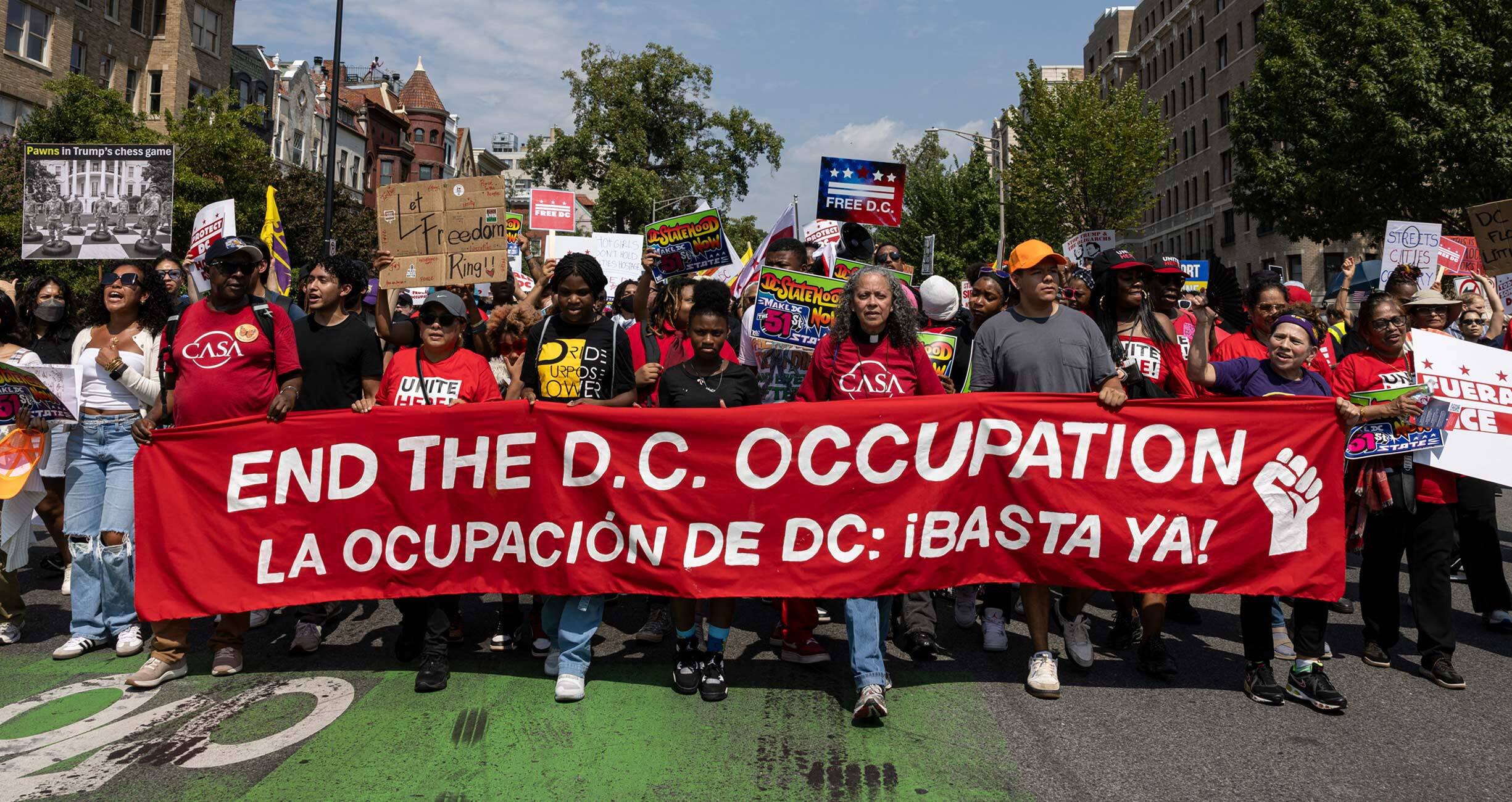
When Donald Trump took to the campaign trail in 2024, the country was already well on its way to becoming safer than ever before. But that did not stop the president from railing about communities “plagued by bloodshed, chaos, and violent crime,” wrongfully blaming immigrants for crime, and even floating a “violent day” of policing to end crime entirely.
Eighteen months into President Trump’s second term, the White House is singing a different tune, calling declining crime “the direct result of the Trump Administration’s relentless efforts to enforce the rule of law, back the police, and surge resources into communities long abandoned by Democrats.” In particular, they have credited the president’s deployments of federal agents and National Guard troops, incorrectly arguing that “the steepest homicide drops have come in cities where the Trump Administration stepped in after Democrat leaders failed to act.” The Department of Homeland Security (DHS) backed Trump’s favored explanation for declining crime, stating “When you remove criminals from the country, crime rates fall”—even though the vast majority of people detained by U.S. Immigration and Customs Enforcement (ICE) have no criminal convictions and research is clear that immigration does not cause crime.
From the start, many observers predicted the president’s federal deployments would not make cities safer. Now, 18 months’ worth of research, in-depth reporting, and polling show something worse: they are actively undermining public safety across the country.
1. While President Trump claims these deployments are meant to fight crime, their main purposes are immigration enforcement and suppressing dissent.
The president has deployed federal troops and agents for three stated purposes: immigration enforcement (across the country); fighting crime (in Memphis, New Orleans, and Washington, DC); and responding to immigration protests (in places like Minneapolis and Los Angeles). His administration has sought to keep these categories discrete, but in reality, they all stem from the false beliefs that public safety will come from removing immigrants and by imposing his preferred brand of “law and order” on cities that oppose his agenda. The president’s executive orders establishing the Memphis and DC deployments barely mention immigration at all, and yet immigration enforcement in each city skyrocketed with the deployment. Memphis residents have described the operation there as no different from ICE surges in Chicago and Minneapolis.
Each “crime-fighting” National Guard deployment has been accompanied by a surge in immigration enforcement. This was exemplified in New Orleans, where 350 Guard troops deployed in support of federal agents, which already included 250 Custom and Border Patrol agents as part of DHS’s Operation Catahoula Crunch. On top of the Guard, the DC deployment included roughly 500 federal agents and the Memphis deployment included more than 700, with the full alphabet soup of agencies participating in immigration enforcement.
The arrest numbers tell a clear story: ICE street arrests nearly doubled in DC during the federal takeover, and during the first two months, about 40 percent of the deployment’s arrests were immigration-related. Similarly, ICE street arrests in Memphis increased from just 14 in September to 260 in November, and roughly 20 percent of arrests were immigration-related during the first two weeks. Moreover, the Memphis Safe Task Force has used traffic stops as its main tactic—issuing more than 28,000 traffic citations in the first two months—and nearly 90 percent of immigration arrests in Memphis began as traffic stops.
To President Trump, this is proof these operations are working. He recently explained that his approach to public safety works “because we take people out and bring them back to the country from where they came.” But the evidence is very clear that immigrants do not raise crime rates and there is no link between crime and unauthorized immigration. And for all of DHS’s fearmongering over arresting “the worst of the worst” (a term revived from similarly false claims related to Guantanamo Bay), studies find that only 34 percent of immigrants arrested by ICE during Trump’s second term have a criminal conviction (some of which may be as minor as a traffic arrest) and only 3 percent of people detained during the first 14 months of Trump’s second term had a conviction for a violent felony. In some federal deployments, those numbers are even lower—for example, in Memphis, only 2 percent of those swept up in immigration arrests were also arrested for violent crimes.
But from a public relations standpoint, the administration’s “crime-fighting” branding appears to be a success. The deployments in Memphis, DC, and New Orleans have not attracted the kind of national scrutiny or resistance as did explicitly immigration-focused operations in places like Chicago and Minnesota. Even the four shootings by the Memphis Safe Task Force have drawn little national attention. By cloaking these deployments in the guise of “crime-fighting” and by deploying to states with friendly leadership (or with no say in the matter, as in the case of DC), the administration has managed to carry out its immigration enforcement goals with the “softer touch” the president has touted.
2. The evidence clearly demonstrates that these deployments have not made us safer.
President Trump has used declining crime to validate his deployments. Since crime was falling before the deployments, the deployments could appear to have reduced crime. Muddying the waters further, many experts agree that deploying federal agents can suppress crime in the short term, for example by scaring people inside. But the resulting destabilization may increase crime in the longer term (as may be happening in DC). Until recently, all this made it difficult for experts to parse out the effects of Trump’s deployments.
Now, two studies have attempted to answer the question, and both determined that deployment of federal troops did nothing to reduce violent crime. A study by the Niskanen Center looked at the Guard deployment in DC, while a study by the Center for American Progress (CAP) looked at Guard deployments in DC, Los Angeles, Memphis, and New Orleans. The Niskanen researchers found that the deployment in DC led to a 24 percent drop in opportunistic property crime that their analysts believe could’ve been achieved “for much cheaper, if you just were very thoughtful about policing.” They found “no measurable effect on violent crime.” The CAP report finds “no evidence that National Guard deployments have reduced violent crime,” adding that “the coinciding operations of federal immigration enforcement strengthen the conclusion that there is no evidence that any of these extreme tactics have meaningfully improved public safety by reducing violent crime in the United States.”
None of this matters to the president, who has used false claims about rising crime to justify the deployments and then made far-fetched claims about eliminating crime in these cities entirely. For an administration with a single-minded belief in “law-and-order” tactics and a complete lack of accountability, the deployments’ results don’t matter, as both rising or declining crime can be used as justification for further heavy-handed federal intervention.
3. The deployments are not just ineffective, but also actively dangerous, bringing chaos, violence, and fear to communities posing no public safety threat.
After more than a year of violence by federal agents, July 2026 drove home the full scope of this danger. ICE killed Lorenzo Salgado Araujo in Houston and Joan Sebastián Guerrero in Maine—bringing its total to at least nine fatal shootings since last January. Meanwhile, the Memphis Safe Task Force killed two people in four days—one shooting by a Drug Enforcement Administration agent and another by a National Guard soldier—bringing the operation’s death toll to four people, all Black men.
These latest tragedies are just the tip of the iceberg: an American Civil Liberties Union (ACLU) report looking at immigration enforcement across eight states found more than 400 incidents of misconduct by federal agents, including 375 incidents involving use of force or threatened force by agents. U.S. lawmakers have come to accept an astronomical level of violence by law enforcement, but there is at least some level of training and accountability at the state and local level that attempts to deter needless violence. But federal agents are nottrained for this kind of law enforcement and under this administration face no accountability, which permits and even empowers such violence.
Reports from within the communities affected by these deployments make clear that this is not safety. From Memphis to Minneapolis, residents describe themselves under “occupation” by their own government. In DC, the public school system had to send out guidance on getting children to school safely. In immigrant communities terrorized by federal agents, people are afraid to go to work, school, and medical appointments. A new study shows that heightened immigration enforcement can actually increase crime by making people afraid to interact with law enforcement.
Even when federal agents are doing what might be described as a real “crime-fighting,” they appear to be relying on disproven broken windows tactics that harm communities in the long run. According to the Manhattan Institute, the Memphis deployment is “aggressively targeting criminals,” but the evidence suggests otherwise. The deployment’s reliance on traffic stops indicates a dragnet approach at odds with the administration’s proclaimed strategy. Not only is this approach ineffective, it can also lead to physical, psychological, and economic harm, as well as diminished trust in law enforcement. Similarly, over the first two weeks of the DC deployment, more than 80 percent of arrests made were for misdemeanors, traffic offenses, or warrants, not serious crime. The uptick in arrests has added strain on court and jail systems, as in Memphis. Even if they reduce crime in the short-term, these tactics can leave lasting harm and undermine community safety and stability in the long run.
Further, the deployments have endangered people expressing their first amendment rights to oppose the deployments. The killings of Renee Nicole Good and Alex Pretti reverberated across the nation. The ACLU’s report found 150 incidents of agents targeting, using force on, and arresting protesters, journalists, or other witnesses who posed no threat to law enforcement. Even those who have not been physically harmed may be under government surveillance. In a safe society, people must feel safe expressing their opinions.
Finally, these deployments have diverted personnel meant to deliver safety elsewhere. The National Guard is meant to respond to national emergencies like floods and hurricanes. DHS agents have critical responsibilities related to counterterrorism and cyber security, but have instead been pulled into immigration enforcement, putting communities at risk for future terrorist attacks. Bureau of Alcohol, Tobacco, Firearms and Explosives agents play a role in stemming the flow of illegal guns into our streets, but has shifted some of its focus to immigration resulting in a slowdown of gun prosecutions. Federal Bureau of Investigation agents investigate serious, violent crimes, yet nearly one-fourth of the agency has been re-assigned to immigration enforcement. The Federal Emergency Management Agency has suffered as their recruits are redirected to support ICE. We may never fully quantify the lives lost and other catastrophic effects due to the Trump administration’s prioritization of immigration enforcement and “crime crackdowns” above all else.
4. The deployments divert resources—federal and local—from what actually works.
The Congressional Budget Office (CBO) found that by the end of 2025, President Trump’s National Guard deployments (excluding New Orleans) had cost approximately $496 million. This includes the cost for soldiers who sat on standby as courts blocked illegal deployments.
CAP has estimated that these deployments could exceed $1.7 billion by the end of 2026, and the CBO estimates that the DC deployment alone could cost another $1.4 billion through the end of Trump’s second term. Of course, these costs are nothing compared to the $240 billion DHS has received.
The costs go beyond federal funds, especially hitting the places facing deployments. For example, Minneapolis had to spend $10 million on police overtime during Operation Metro Surge, while Los Angeles spent more than $22 million during the deployment of federal agents, National Guard troops, and Marines last summer. Cities facing deployment have also seen depressed tourism as well as hits to local businesses in areas where residents have been afraid to go. The deployments are also playing a role in what is likely to be a $21 billion deficit in foreign tourism this year. The loss of immigrants is not only immediately affecting the country’s workforce but also its long-term economic prospects.
In contrast, President Trump has slashed funding across programs that deliver safety. Last year, the Department of Justice (DOJ) cut $500 million in grants supporting violence prevention, victim services, treatment, and much more. He has decimated drug and mental health treatment, including by gutting the Substance Abuse and Mental Health Administration (SAMHSA) and more than $2 billion in block grants and treatment funding combined. From health care to food assistance to affordable housing, the list of federal cuts undermining safety is extensive. Some of these cuts have specifically targeted states that have opposed Trump’s deployments.
If the administration truly wanted to help U.S. cities become safer, it would fully fund things that are proven to create safe communities—like good schools, jobs, and affordable housing, mental health care and drug addiction treatment, and effective, accountable policing. The administration should also support local governments to deliver safety on their own terms rather than insisting on the president’s harmful vision of “law and order.”
5. The public doesn't buy Trump's framing, and elected leaders who care about public safety should go on offense.
Across the board, polling shows that Americans do not want these deployments. President Trump is now underwater with the public by an average of 5 points on crime.
Residents of affected communities have rejected these deployments from the start. At the onset of the DC deployment, a Washington Post poll found that about 80 percent of DC residents opposed the deployment and 65 percent felt it would not make them safer from violent crime. There are no local polls in Memphis, though a state poll showed support for deploying the National Guard, indicating a divide between the predominantly white Republican-dominated state of Tennessee and majority Black Democrat-led city of Memphis, where the deployment has been met with protests and fear.
In national polls, voters consistently oppose both the DC and Memphis deployments, as well as this use of the Guard more broadly. In September 2025 polling, 52 percent of people opposed deploying the Guard to their local area, even though 71 percent said crime is “unacceptably high.” Fifty-eight percent in an October 2025 polling said they don’t want troops deployed without an external threat. An August 2026 Vera Action poll showed that 48 percent of voters said they would prefer to end these deployments immediately, compared to only 29 percent who would extend them (23 percent were not sure).
Looking at the full breadth of federal deployments, Vera Action polling in February 2026 found that a narrow plurality (49 percent of voters versus 46 percent) oppose “federal agents, including ICE, the National Guard, and the military, being deployed to American cities.” A July 2026 poll from Vera Action shows that the public clearly does not buy the president’s supposed rationale:
On ICE deployments, the response is even more stark. A February 2026 poll showed that nearly two-thirds of Americans believe ICE has gone “too far” and 62 percent believe ICE is making people less safe. As of July of this year, a majority of Americans had little or no confidence in ICE and about half support abolishing ICE entirely. In January, 53 percent of voters said ICE was making people less safe in Minneapolis—with only 55 percent of GOP voters, who still broadly support the president’s immigration agenda, saying ICE was making people more safe.
Importantly, while polling reveals that support for the deployment often continues to divide along partisan lines, moderates reject the deployments. In Vera Action polls from July and August, a majority or plurality of moderates said:
- they oppose the deployments of National Guard and federal troops to American cities
- federal deployments have made the country less safe
- the president’s deployments are for political theater
- they have little or no confidence in ICE
- ICE has used excessive force
In particular, moderates appear to oppose the cost of the deployments: the most compelling message for this group was, “We are spending well over $1 million in taxpayer dollars every single day to surge troops into Washington DC without any significant impact on public safety. We could use that money on serious safety efforts, not political theater.”
Finally, despite the administration’s professed support for law enforcement, the deployments appear to be undermining the public trust law enforcement officers need to do their jobs effectively:
Local law enforcement has already warned of this. For example, during the Minneapolis surge, one local police chief said, “It’s impacting our brand as police officers, our brand of how hard we work to build trust.”
The public overwhelmingly wants law enforcement to be used effectively towards delivering safety at a local level, not enforcing the president’s destabilizing anti-immigrant agenda:
Candidates who did not strongly oppose these deployments have already suffered at the polls. This polling makes clear how much candidates and policymakers stand to benefit politically from taking a strong stand.
It Is Far Past Time to End These Harmful Deployments
The evidence is clear that these deployments are not delivering safety and that the public opposes them. Nevertheless, ICE enforcement continues to intensify, the DOJ will soon announce the first four cities participating in a $300 million grant program modeled off its federal deployments, current deployments are being extended, and there are reports the president is considering additional deployments, particularly to cities in states with Republican leadership. While the White House originally framed these deployments as “emergency” responses, it is clear they were intended to create a new normal.
It is imperative for lawmakers and midterm candidates to reject the president’s “law-and-order” tactics and contrast them with harmful cuts to lifesaving programs that have delivered real safety.