
“I Can Put My Guard Down”: How Restoring Promise Is Changing Prison Culture
The Restoring Promise approach is strengthening relationships, fostering accountability, and creating a healthier workplace for corrections professionals while helping young adults prepare for life after prison.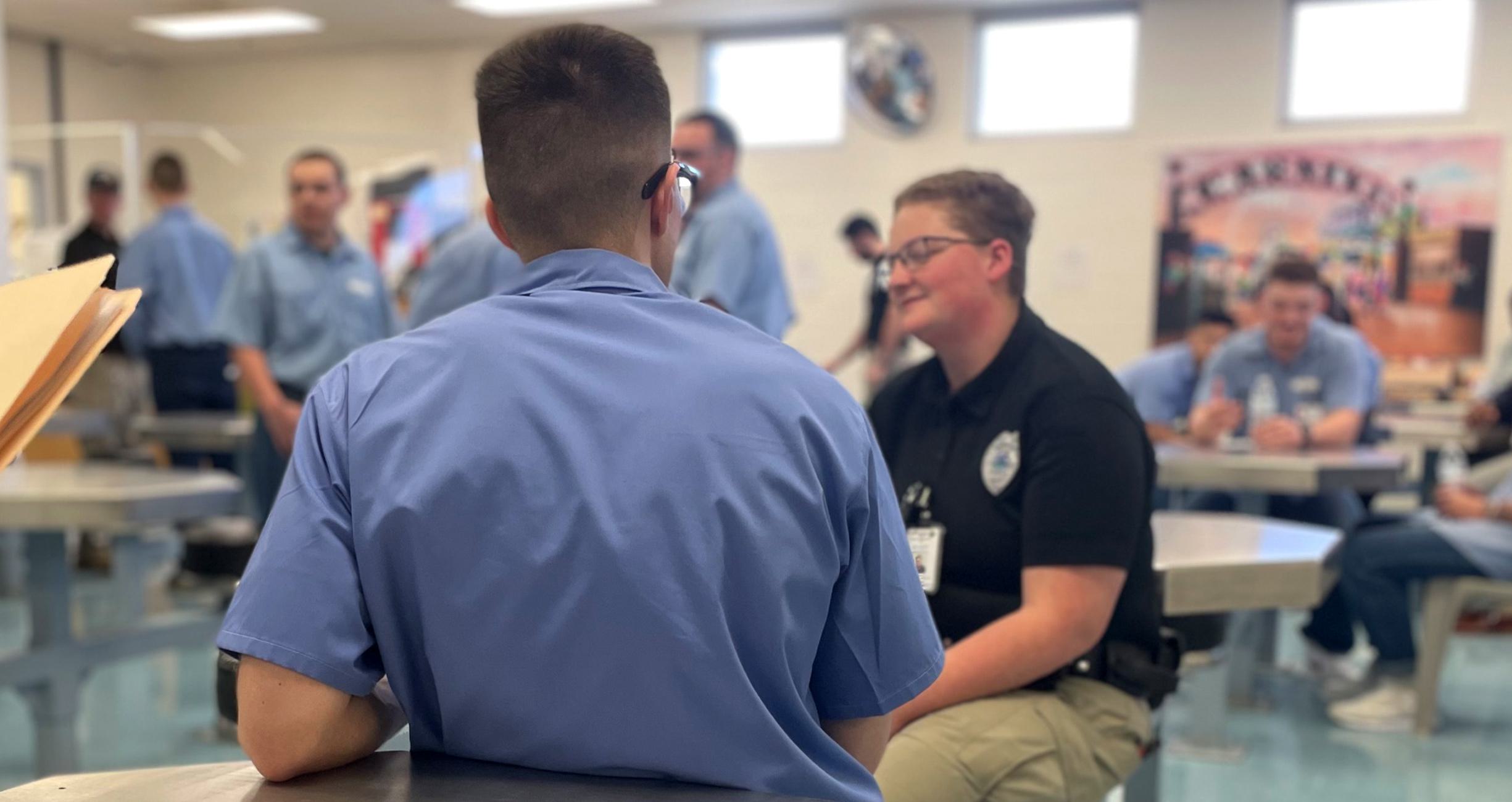
Correctional Sergeant Admir Efendic used to be on high alert when patrolling the section of Idaho State Correctional Institution (ISCI) that is now Cornerstone Village. The gray-walled unit was known for fights, drugs, and trouble, he said. “You would walk in and focus on security.”
On a recent Wednesday, he greeted several residents with a smile and a handshake, and sat down to join them in their morning circle, a daily routine of coming together in community to start their day. They kicked it off by learning a word of the day, “forspent.” Then each took a turn sharing challenges and setting goals before heading off to start their work for the day.
The Vera Institute of Justice’s (Vera’s) Restoring Promise initiative, ISCI corrections officials, and a group of young incarcerated men and their mentors have worked hard to transform this unit and build a culture grounded in accountability, dignity, learning, and healing. “I am committing to a new chapter in my life, one that is built on unity, trust, and mutual respect,” reads the pledge on the walls, which have been painted a warm green and are covered with photos and art.
These are not simply words. Research shows that young adults who serve sentences in one of Vera’s Restoring Promise units experience a 73 percent reduction in the odds of a conviction for a violent infraction and an 83 percent reduction in the odds of a restrictive housing stay.
“We provide an alternative to prison norms,” said Maurice, who is incarcerated and a mentor in Cornerstone Village. “The way things were doesn’t mean that is the way it always has to be.”
The Restoring Promise approach was inspired by Vera’s visits to prisons in Germany, where the constitution states that “human dignity is inviolable. To respect and protect it is the duty of all state authority.” This principle is reflected in German prisons, where the sole purpose of incarceration is to help people lead independent, productive lives in society once they are released. Toward that end, the conditions of incarceration and the expectations of corrections professionals are designed to promote safety and dignity.
Lessons from German prisons reflected in the Restoring Promise approach have sparked real reforms in United States prisons, with young adult housing facilities now operating from Connecticut to South Carolina to Idaho. “When you go from a traditional unit to a Restoring Promise unit, the contrast is abundantly obvious,” Officer Hernandez said. “When I am in [Cornerstone Village], I feel more relaxed. You don’t have to be as alert. The more they can expand this program, the safer it will be for staff as well.”
The Restoring Promise approach is grounded in the following:
- Mentorship. Older incarcerated mentors provide space, safety, and guidance to help younger adults grow, transform, and follow their goals. They share feelings, hopes, and challenges.
- Staff partnership. Staff partner with people living in the unit to engage in “dynamic security”— relationship-building that improves conditions for all people living and working on the unit.
- Normalcy in the living environment. The physical conditions within the unit mirror community living as much as possible. There are thriving plants, teeming bookshelves, and framed pictures of residents holding their children and grandchildren.
- Restorative justice and family engagement. Punishment is replaced with restorative justice practices that focus on repairing harm through communication. Families are invited to be a major part of residents’ growth.
Idaho Department of Correction Chief of Institutions and Operations Chad Page supported bringing Restoring Promise to ISCI because he disliked seeing people have worse outcomes in prison. “I watched several young adults come in on a two-year sentence and get caught up in prison politics and end up with a higher sentence. I really felt like we could do better to get them on the right path.”
Page says he is a firm believer in the approach. “Most prisons are gray and white and not very conducive to development. We wanted this to be a safe space, or as close to that as you can get inside a prison. We want them to see a different path so that when they get released, they have the tools and means to be successful.”
Hernandez monitors several units from his tower in ISCI. For the most part, he looks down on a sea of gray cinderblock. In Cornerstone Village, the colorful walls and thriving plants offer a unique oasis.
“Cornerstone Village residents are on top of their day, they don’t have to be called to go to their assignments, they become more responsible, they don’t need reminders, and they become less reliant on officers,” said Hernandez. “Here the path to rehabilitation is much faster. It puts rehabilitation on overdrive.”
By prioritizing punishment as a public safety strategy, the United States has created dangerous prisons that harm the people who live and work in them. Eighty-five percent of corrections officers report having seen someone seriously injured or killed in the workplace. Corrections staff often experience poor health and rates of PTSD comparable to those of returning war veterans.
Things are different in Cornerstone Village.
“The interactions between residents and staff, and the overall atmosphere when you walk into that housing unit, are unlike anything else in the prison,” said Deputy Warden Luke Kormylo. “The tension seems to lift when you walk onto the unit. You know you're entering a community of mentors and young men who have committed themselves to making positive choices, respecting one another, and treating staff with respect.”
Efendic, who has worked on the unit since it opened, agrees. “When I go to [the Restoring Promise unit] I can put my guard down,” he said. “I can be Admir instead of Sergeant Efendic.”