
AI Hiring Tools Could Lock Out People with Conviction Histories
Finding employment after incarceration was already hard, but bias in AI hiring tools is making the job search more difficult. Policymakers must act now to prevent further harm.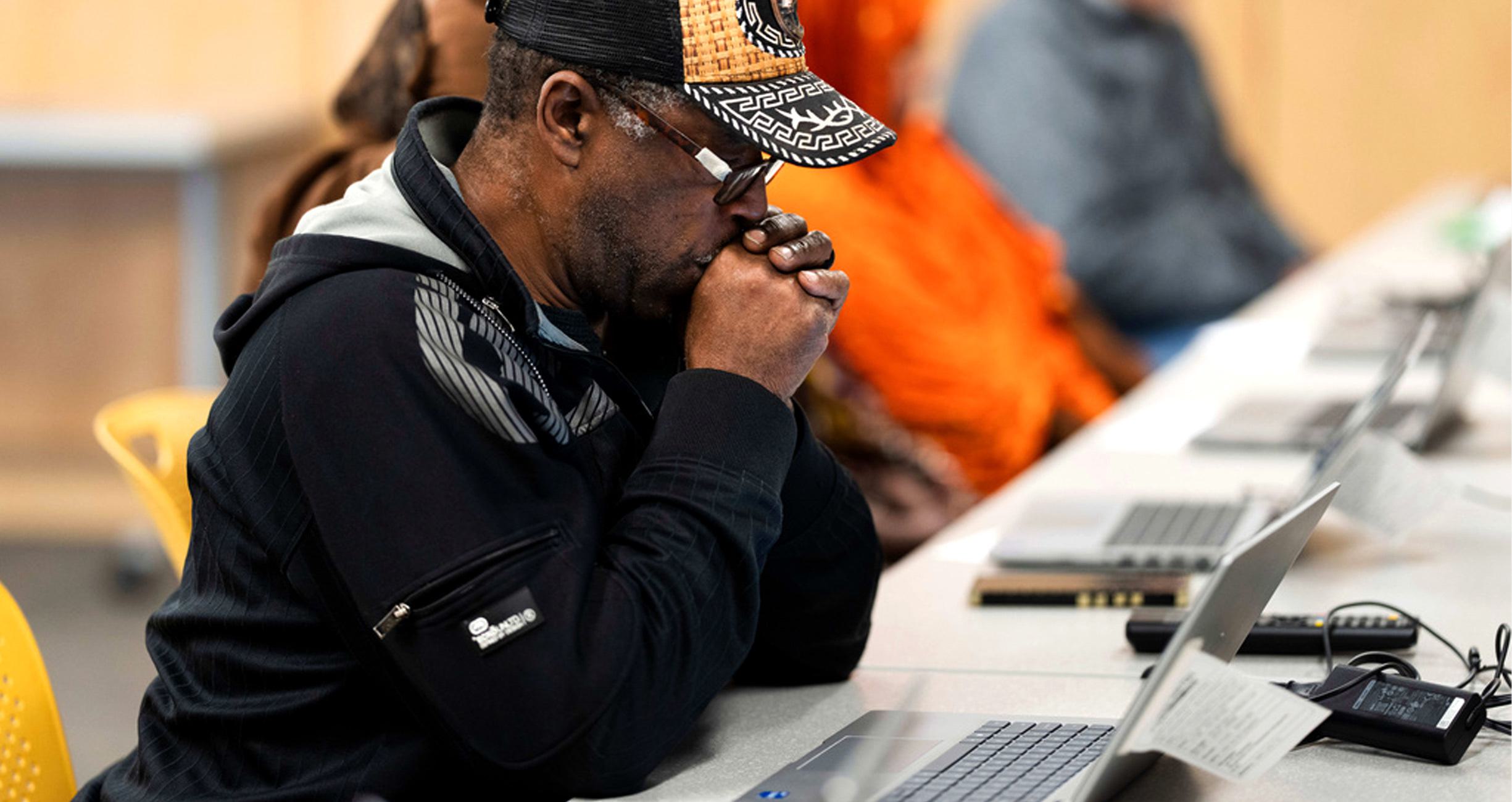
For people leaving prison, finding a job is one of the strongest predictors of a successful return to community life. Research suggests formerly incarcerated employees can be a real asset in the workplace: a peer-reviewed 2018 study of entry-level hires found that employees with conviction histories stayed in their jobs longer and voluntarily quit less often than their peers without conviction histories—a retention advantage that saved employers real money. But artificial intelligence (AI) now plays an increasingly prominent role in filtering job applications before they ever reach a human reviewer. New research suggests AI hiring tools may be reinforcing barriers that already stand between formerly incarcerated people and steady work.
A new barrier to entry: AI hiring tools could shut formerly incarcerated applicants out
Employers have rapidly adopted AI hiring tools over the past several years, using them to screen résumés, rank candidates, and predict who is likely to succeed in a role. A recent Stanford study found that because so many companies rely on a small number of AI hiring vendors, an “algorithmic monoculture” has emerged: when one tool’s bias shapes a rejection, that bias doesn’t stay contained to a single employer. Candidates are more likely to be rejected across multiple employers, potentially shutting qualified applicants out of the job market entirely. The same research found that these tools also increase racial disparities in who gets hired.
Layer a conviction history on top of that dynamic, and the effect compounds. Because algorithmic hiring systems can reproduce existing patterns of discrimination, formerly incarcerated applicants are at risk of being excluded from the labor market before their application ever reaches a hiring manager—no matter how strong their performance could be once on the job.
Could AI deepen the economic inequalities of incarceration?
If AI hiring tools are making it harder for people with conviction histories to get hired, they may be reinforcing the very inequalities our data already shows. The Incarceration and Inequality Project at the Vera Institute of Justice (Vera) documents how incarceration shapes economic outcomes long after a sentence ends, with elevated rates of unemployment, poverty, and financial instability persisting in communities with high incarceration rates. Employment is one of the clearest pathways through which those harms can compound or heal. AI threatens to make the job market harder: those carrying the heaviest burden of incarceration, poverty, and unemployment may also be the ones most likely to get screened out of a job before a human reviewer ever sees their application.
The economic harms of incarceration are not evenly distributed. In Fresno County, California, for example—home to roughly a million residents—the total incarceration rate was 1,089 people per 100,000 in 2019, well above the national mean of 768 per 100,000 U.S. residents ages 15–64. In 2024, nearly one in five residents, or 18 percent, lived in poverty, and unemployment sat at 9 percent. The racial gap is stark: Black residents face a 12 percent unemployment rate—twice the 6 percent rate for white residents—and are incarcerated at a rate of 4,097 per 100,000, more than six times the white incarceration rate of 665 per 100,000.
Fresno County is not an isolated example: it is one of 175 U.S. counties in Vera’s Data Explorer dataset where incarceration, poverty, and unemployment rates are all above the national median, and where Black residents are incarcerated, unemployed, and living in poverty at higher rates than white residents. In these places, people with conviction histories are already competing for scarce employment opportunities. Good jobs—those that pay a living wage and are in demand—are scarcer still, often accompanied by regulatory barriers that limit eligibility for formerly incarcerated people across the country.
What automated job screening looks like to applicants
Emiliano López, a formerly incarcerated justice advocate, now leads Project Protocol, a nonprofit that uses data “for liberation, not exploitation.” After his release in 2016, López applied to job after job through sites like Indeed and Glassdoor. Most applications ended the same way. “It was just constantly an impersonal loop of filling out an application and then receiving . . . a boilerplate response,” he told Vera. “And they all seemed identical.”
López still doesn’t know how many of those rejections came from a person. “To this day, I don’t even know if it was a computer or a human that was emailing me,” he said. “I just don’t know.”
The use of AI in hiring processes may be inevitable, but the technology can be designed to address biases and ensure that human screeners are involved. López is careful to separate the technology from the people who design it. “I don’t think it’s the technology that’s the issue,” he said. “I think it’s the people that program the technology to create these categories where when people fill out that application . . . they’re instantly categorized into . . . either a yes or a no or a maybe.” In his view, “it’s just who’s creating the tech . . . that really creates these . . . systems to basically eliminate the people that they don’t want and find the people that they do.”
Eventually, López stopped applying to traditional employers altogether. “I gave up because I’m like, this is not for me. [I’m] obviously not accepted in these spaces,” he said. Instead, he built his own organization—a place where, he said, “my background had value and it can help people,” instead of being treated as a liability.
How can we keep AI tools from automating inequality and shutting people out of work?
Some policymakers are already responding. New York City’s Local Law 144 now requires independent bias audits of automated hiring tools before employers can use them. Similar transparency and accountability measures have been proposed at the federal level, including the No Robot Bosses Act, which would require human review and bias testing of automated hiring systems. Advocates argue this kind of oversight should become standard practice, not the exception.
It’s also worth noting that biased hiring systems don’t only harm formerly incarcerated applicants. Once bias is embedded at scale, it can quietly narrow opportunities for many different groups at once—which is exactly why interrogating these systems now, before they become further entrenched, matters for everyone.
The economic consequences of incarceration don’t end at release. As employers lean further into automated hiring, AI tools risk scaling up the very barriers that have long kept formerly incarcerated people out of stable work—people who, as the research on retention shows, can bring real, lasting value to an employer willing to give them a shot. Further, securing stable employment is a critical factor in reducing recidivism among formerly incarcerated people. When considered alongside unemployment and poverty in high-incarceration communities demonstrated in the IIP Data Explorer, this raises an urgent concern that AI hiring systems may not be expanding opportunity and may instead be reinforcing the barriers that limit it.
Lawmakers should act now, before these tools deepen existing inequalities. That means requiring independent bias audits, greater transparency about how hiring algorithms evaluate candidates, and meaningful accountability when these systems unfairly exclude applicants with conviction histories. Employers should ensure that automated screening doesn’t prevent qualified candidates from ever reaching a human reviewer. People returning home from incarceration deserve an opportunity to rebuild their lives. That means finding meaningful, stable employment. Rather than investing in AI tools that can perpetuate harm, we must invest in people.