
Democrats’ Demands for ICE Accountability Could Be Effective—If They Can Be Enforced
Congressional Democrats sent Republicans a list of 10 demands for ICE accountability. These policies could help rein in ICE overreach, but they must be accompanied by clear enforcement measures.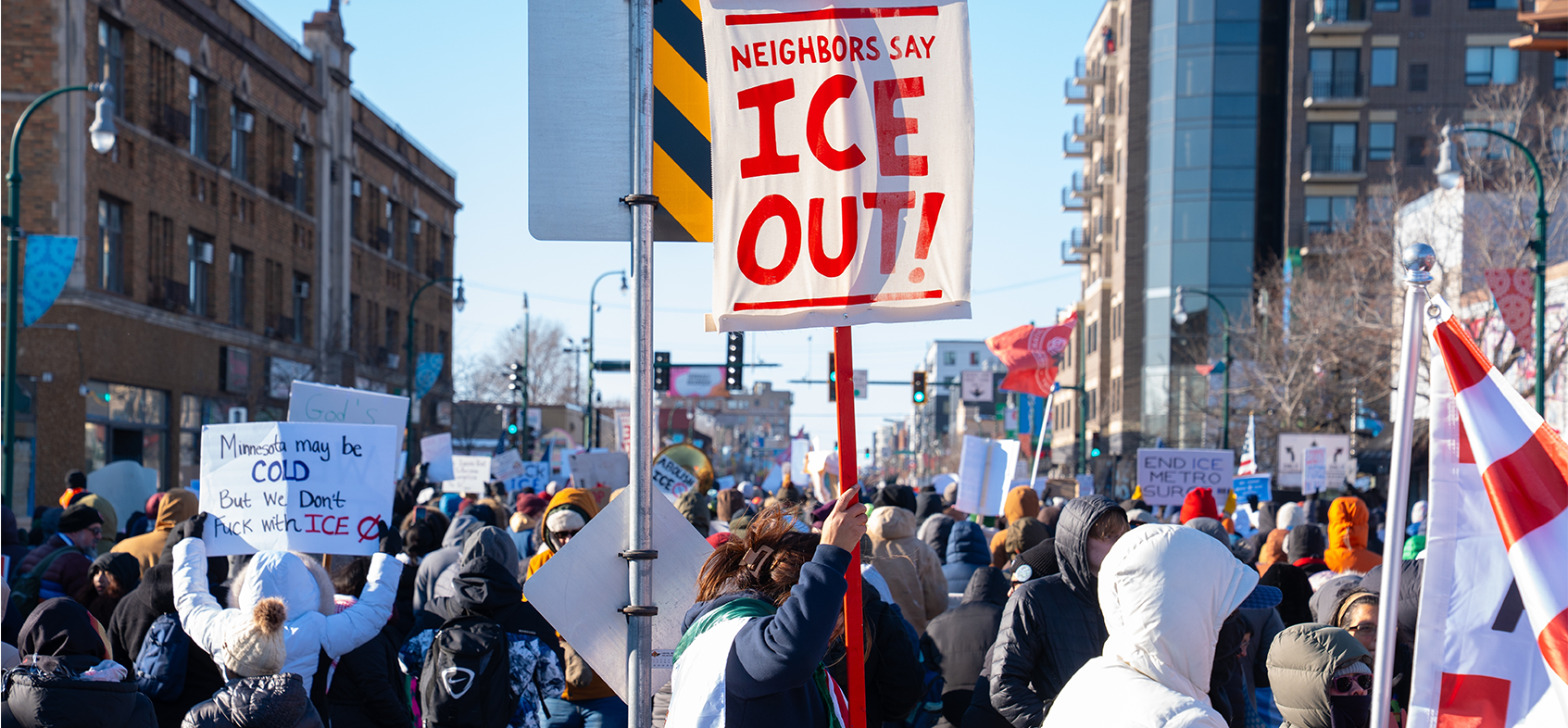
Under President Trump’s mass deportation agenda, United States Immigration and Customs Enforcement (ICE) has turned into an out-of-control paramilitary force. The public agrees, with nearly two-thirds of voters now saying ICE has “gone too far” as the nation witnessed the killings of Renée Good and Alex Pretti by federal law enforcement. Using a funding deadline for leverage, last week Democratic leadership revealed their list of ten demands, which they subsequently incorporated into draft legislation for holding the Department of Homeland Security (DHS) and ICE accountable.
While Democrats are heeding public outrage for more accountability, early signs suggest they are not fighting to cut funding—the most obvious way to rein in ICE. The robust list of demands, including some that are nonstarters for Republicans, demonstrates that they are unified and serious about standing up to Trump on ICE. However, they appear to be relenting already on the most basic of changes, like prohibiting federal law enforcement officers from wearing face coverings. And Democratic leadership has studiously avoided any talk of cutting funding—despite this being an appropriations fight.
Most of the demands from Democratic leadership are effectively asking DHS to simply follow the law and existing guidelines. ICE already knows—and disagrees—about the need for judicial warrants. They already have a use-of-force policy and body cameras. So, what will make them change now? In a ruling filed at the end of January, a federal judge wrote, “ICE has likely violated more court orders in January 2026 than some federal agencies have violated in their entire existence.” This is not an agency interested in following the law or reforming itself; so much depends on how lawmakers can put real teeth on these policies (beyond existing, ineffective mechanisms).
Moreover, Democratic leadership rejected a set of demands from advocates to leverage the budget fight explicitly. More than 30 national organizations from the immigrant justice, civil rights, and labor movements came together with a list of demands to halt all funding for ICE until their agents completely withdraw from cities where they are currently deployed. The demands also recommended clawing back some of the billions that went to ICE from the One Big Beautiful Bill Act to fund Medicaid and other life-saving services that have been cut (a proposal that even received two Republican votes).
The accountability demands from Democratic leadership are triggering déjà vu for many criminal justice and immigration advocates from the last decade of police reform—and raise serious concerns about whether they will work. At the press conference introducing the demands, Hakeem Jeffries explained, “We believe that ICE should conduct itself like every other law enforcement agency in the country.” It is true that ICE has been making local law enforcement look like saints. But police killed more than 1,200 people in 2025—at least 100 more people than when states began passing laws to require body cameras in 2015. The measures Democrats are demanding are simply tools—ones that only work if they are backed by rigorous enforcement mechanisms. In police reform, calls for large-scale change have often resulted in modest reforms, which, while valuable, are insufficient to solve the issues. Democrats could easily end up with a set of watered-down demands that do not meet the moment, outside of giving them something to campaign on.
ANALYZING DEMOCRATS’ TEN DEMANDS
Below is a deep dive into the ten demands presented by Democratic leadership to rein in ICE. Where analogous, we explore the track record of these proposed reforms and its impact (and lack thereof) in the police accountability and oversight context.
- “Targeted Enforcement - DHS officers cannot enter private property without a judicial warrant. End indiscriminate arrests and improve warrant procedures and standards. Require verification that a person is not a U.S. citizen before holding them in immigration detention.”
Democrats want DHS to start properly obtaining judicial warrants and stop detaining U.S. citizens—all of which the agency is already supposed to do. ICE has been relying on administrative warrants, which are issued by the agency itself and do not have to be signed by a judge. These warrants allow federal officers to make arrests but, unlike judicial warrants, they do not allow entry into non-public areas, searches, or seizures. However, a recently disclosed ICE memo reveals that the agency has been instructing officers that they are authorized to use administrative warrants for searches and seizures, which contradicts Fourth Amendment protections. By maintaining its ability to make warrantless arrests, DHS can rove the streets and conduct mass raids rather than engage in targeted and lawful enforcement. The impact of DHS making indiscriminate arrests goes beyond undocumented immigrants: ProPublica found in October that DHS had illegally detained more than 170 citizens, leading many people to carry passports at all times.
- “No Masks - Prohibit ICE and immigration enforcement agents from wearing face coverings.”
Democrats’ most straightforward (and popular) demand is not a panacea for accountability and restoring trust, but it is a critical first step. ICE and Republicans make the dubious claim that agents wear masks for their own safety, but the facts show that agents are overall very safe—more so than civilians. In practice, ICE’s face coverings seem more like an intimidation tactic and a way to avoid accountability. While no federal law or rule currently prohibits ICE from wearing masks, the practice carries real risks by making agents harder to identify in real time, thus removing accountability and opening the door for abuses. Masking also raises operational dangers by increasing the chances of mistaken intervention by local police, including friendly-fire incidents, or by bystanders, who may mistake ICE arrests for crimes like kidnapping. As a result, California recently passed a mask ban for law enforcement officers and civil penalties for violations, though these state-level bans are likely to face legal challenges under federal preemption of state laws.
Evidence shows that transparency in law enforcement makes everyone safer. When police explain their actions, treat people with dignity, and act with transparency, people are more likely to view them as legitimate and to voluntarily comply. Treating people respectfully decreases the likelihood of a violent encounter.
As clear as the evidence is that banning masks is sound policy, top Democrats are already capitulating on their original “no masks” demand: Schumer said masks should only be used in “extraordinary and unusual circumstances,” while Jeffries argued they shouldn’t be worn in an “arbitrary and capricious fashion.” These exceptions will create openings that an agency notorious for lack of compliance will certainly exploit. Any policies resulting from these negotiations must be strict, clear, and enforceable—or they are unlikely to have any major impact.
- “Require ID - Require DHS officers conducting immigration enforcement to display their agency, unique ID number and last name. Require them to verbalize their ID number and last name if asked.”
Similar to masks, identification requirements ensure ICE agents operate with transparency and can be held accountable when things go wrong. Accountability breaks down when ICE agents fail to clearly identify themselves. Federal regulation already requires immigration officers to identify themselves “as soon as it is practical and safe to do so,” but DHS has not enforced that requirement. Without visible ID, people cannot reliably report misconduct, families struggle to locate detained loved ones, and oversight bodies lack the basic information needed to investigate. Alex Pretti’s murder underscored this accountability gap: federal authorities declined to disclose the identities of the agents involved, which only became public through a ProPublica investigation.
Identification is a basic feature of policing that is routine and required in many jurisdictions. Republicans and administration officials counter that requiring ICE agents to identify themselves exposes them to doxxing and harassment. Those risks can be real (if exaggerated), but states have increasingly addressed credible threats through criminal penalties and civil remedies, often with protections that explicitly cover law enforcement and other public officials. (It should be noted that attacks on law enforcement are rare and would likely be even more so if officers consistently follow the law.) Asking agents to identify themselves does not expose their families or home addresses; it simply allows their actions to be connected to a complaint, investigation, or review—and can help defuse tense encounters. This would also remove the risk of impersonators as well: in North Carolina, among other incidents, a man posing as an ICE officer used the threat of deportation to sexually assault a woman.
Congress has already taken a similar approach in other contexts. Federal law requires armed forces, including National Guard troops, to display visible identification when responding to civil disturbances. That requirement reflects a judgment that anonymity undermines legitimacy—a principle that applies just as readily to ICE.
- “Protect Sensitive Locations - Prohibit funds from being used to conduct enforcement near sensitive locations, including medical facilities, schools, child-care facilities, churches, polling places, courts, etc.”
These critical locations have been a goldmine for ICE raids that have placed communities in danger and chilled civic participation. For example, recent reporting shows that pregnant women have been afraid to go to doctors’ appointments. No one should be forced to skip medical treatment or flee domestic violence shelters for fear of arrest. These actions undermine the administration’s claims that their immigration enforcement is related to public safety.
Courthouse arrests, in particular, are an issue. Under Trump, one of ICE’s key tactics has been to dismiss people’s immigration cases and then arrest them at the courthouse, allowing DHS to quickly deport them through “expedited removal.” Courthouse arrests also undermine safety by discouraging people from showing up to court or participating as witnesses. States like New York and Illinois have laws to prevent arrests at state courts, but extending protection to federal courts and other sensitive locations would be meaningful.
- “Stop Racial Profiling - Prohibit DHS officers from conducting stops, questioning and searches based on an individual's presence at certain locations, their job, their spoken language and accent or their race and ethnicity.”
Court orders prohibiting law enforcement from engaging in specific racial profiling measures have proved effective in stemming illegal ICE arrests, but broad racial profiling bans are rarely effective. As immigration raids escalated in Los Angeles last June, the ACLU sued DHS for making suspicionless stops based on racial profiling. In response, a federal judge issued a temporary restraining order (TRO) that stopped ICE from sending roving patrols out to arrest people based on race, location, language, and work. The TRO reduced ICE arrests in Los Angeles by 66 percent. However, in September, the Supreme Court ruled 6-3 to halt the TRO, temporarily enabling DHS to resume widespread racial profiling until the Court rules on the merits.
The success of the TRO in Los Angeles is promising—and coupled with other measures, like the requirement of judicial warrants, could help end DHS’s practices of roving patrols making indiscriminate arrests. But there are important lessons from policing. Blanket racial profiling bans have been largely ineffective: they often have no enforcement mechanisms, and violations can be difficult to prove. For example, broad prohibitions against racial profiling have not ended racial disparities in traffic stops—leading lawmakers and advocates to shift to more specific policy changes. As ICE can stop people without a warrant under certain conditions, they should be required to document all encounters for transparency (as many police are required to do under state and local directives and laws).
- “Uphold Use of Force Standards - Place into law a reasonable use of force policy, expand training and require certification of officers. In the case of an incident, the officer must be removed from the field until an investigation is conducted.”
ICE clearly needs better training standards, but training alone will not suffice as reform, and ICE already has a use-of-force policy it routinely ignores. ICE is currently under investigation by its own inspector general (OIG) for “allegations of excessive use of force.” The agency has a use-of-force policy informed by Supreme Court precedent: for all U.S. law enforcement agencies, applied force must be “objectively reasonable” given the circumstances. (ICE’s 2018 policy is available, but the 2023 update is fully redacted.) If officers violate that standard, they can be held liable in civil court—which is all but impossible in reality because of federal law constraints and Supreme Court decisions that make it much harder to sue for law enforcement misconduct than under state law. Moreover, the “objective reasonableness” standard means little in practice: far more often than not, courts apply this language broadly and deferentially to privilege officers, who benefit from the court-created doctrine of qualified immunity. In 2019, the DHS OIG found that “DHS does not have sufficient policies and procedures to address employee misconduct.” So it is unclear what accountability mechanisms will enforce new rules—which should also include guidance around lawful crowd management.
Training may be another matter. ICE has shortened its training period to get new recruits into the field faster and has admitted to accidentally sending some into the field with improper training. But Jonathan Ross, the officer who shot Renée Good, had plenty of training from both his military background and ICE, where he served on the agency’s Special Response Team (SRT). The agents who killed Alex Pretti were also purportedly experienced officers; one of whom had comparable SRT tactical training. These cases underscore the limits of training: the quantity matters little if the underlying use-of-force policies and culture emphasize aggression over de-escalation. While training is important and necessary, the evidence is mixed that changes in internal policies, training standards, certification, and investigations consistently and reliably reduce use of force.
Nevertheless, we know that training for procedural justice and de-escalation can be effective if they are regularly maintained and refreshed, given these skills are “perishable,” meaning that they must be reinforced by regular training updates. They also only work within a department culture that prioritizes safe, respectful, and constructive interactions with the public. As it exists now, no amount of training will “fix” ICE—but paired with the right broader reforms and accountability mechanisms, it could certainly help.
- “Ensure State and Local Coordination and Oversight - Preserve the ability of State and local jurisdictions to investigate and prosecute potential crimes and use of excessive force incidents. Require that evidence is preserved and shared with jurisdictions. Require the consent of States and localities to conduct large-scale operations outside of targeted immigration enforcement.”
This is likely to be one of the most controversial measures among Republicans, but in the absence of real federal investigations, it is imperative. While it is challenging for states and localities to hold federal officers accountable, they do have every right to try. In Minnesota, following the killings of Renée Good and Alex Pretti, the U.S. Department of Justice (DOJ) effectively prohibited Minnesota’s Bureau of Criminal Apprehension from launching an investigation by restricting their access to evidence—a departure from longstanding practice. Given the administration’s robust defense of the involved agents, any DOJ investigation risks appearing partial. In this context, state investigations are essential checks on the administration.
The second part of this measure—requiring the consent of states and localities for large-scale operations—is likely to be so objectionable to Republicans that it has no chance of making it through negotiations. If it passed, it would continue the Trump administration’s habit of operating in red states like Florida and Louisiana with welcoming leadership. There would also be major questions about what constitutes a “large-scale operation” and how much impact ending them would actually have, given that surge operations seem to be more about optics than anything else.
- “Build Safeguards into the System - Make clear that all buildings where people are detained must abide by the same basic detention standards that require immediate access to a person's attorney to prevent citizen arrests or detention. Allow states to sue DHS for violations of all requirements. Prohibit limitations on Member visits to ICE facilities regardless of how those facilities are funded.”
As written, this demand is vague—and once again simply reiterates existing law—but it gestures toward crucial reforms that should be made explicit. Maintaining standards of detention is critical: at least 32 people died in ICE custody last year, amid longstanding allegations of medical neglect, abuse, and other human rights violations. ICE has also repeatedly denied detainees access to legal representation and due process. However, the demand’s language appears to suggest that Democrats could be more concerned about preventing the detention of citizens. Immigration agents only have legal authority to detain U.S. citizens under highly specific circumstances—if they have interfered with or assaulted officers, or if agents suspect they are undocumented—which the agency has still illegally exploited.
The demand to allow states to sue DHS is similarly vague. States can already sue DHS (and do). This language may mean that Democrats want states to be able to sue for any violation of the law, or it may only narrowly apply to violations emerging from this agreement. Nor does it specify whether lawsuits would target the agency itself or individual agents. The administration sued Illinois over its law allowing civil suits against federal agents, arguing that it “chills the enforcement of federal law and compromises sensitive law enforcement operations.” The ability to sue law enforcement in civil court has been a key tool in police accountability, as departments have faced massive payouts and potential loss of insurance.
Finally, the last provision refers to DHS’s attempts to block members of Congress or their staff from exercising their legal right to visit ICE facilities. DHS cannot use any federal appropriations to block visits to ICE facilities. DHS Secretary Kristi Noem argues that funding from the One Big Beautiful Bill Act does not apply—hence the stipulation of “regardless of how those facilities are funded” in the memo. Last week, a judge issued a TRO against the administration’s attempts to require a week’s notice for visits. Ending this long-running battle would be a victory for congressional oversight, but once again, it simply demands that DHS follow laws it has already refused to follow.
- “Body Cameras for Accountability, Not Tracking - Require use of body-worn cameras when interacting with the public and mandate requirements for the storage and access of footage. Prohibit tracking, creating or maintaining databases of individuals participating in First Amendment activities.”
Body cameras have been touted for years as a cure-all for law enforcement abuses, but history shows that they are only effective when accompanied by reliable accountability mechanisms. DHS has consistently failed to meet its goal of making its body-worn camera program fully operational, even attempting to gut the program last year. As of June 2025, ICE had only 4,400 cameras for 22,000 agents. Jonathan Ross wasn’t wearing one when he killed Renée Good, later testifying in Congress, “Our field office does not have a body-worn camera policy; so we cannot wear them.” ICE does have a policy instructing officers to turn on body-worn cameras “as soon as practicable” during operations, but it only applies to some offices.
The long history of body cameras in police reform makes it evident that these tools alone will not rein in ICE’s reckless violence. After police officers murdered Michael Brown in 2014, body-worn cameras were widely adopted to hold police accountable (often through state mandate). But since 2014, police killings have only gone up. For body cameras to be effective, there have to be clear policies around their use (including requiring them to be turned on), requirements to release the footage, and mechanisms to hold officers accountable with the evidence. These conditions have been difficult to enforce with local police and will likely be even harder to enforce with ICE.
Democrats’ mention of protecting protesters is important (and should be expanded to include cell phone cameras). Last week, reporter Ken Klippenstein found that DHS and the FBI are keeping secret watch lists of protesters. DHS is spending massively on AI surveillance, and they may have been tracking Alex Pretti based on a previous encounter. There are longstanding concerns about the use of body cameras for surveillance, particularly because they only film a narrow perspective and can be used as a weapon against the surveilled—for example, a 2016 study found that 92.6 percent of body camera footage was used to prosecute civilians. A decade of experience clearly shows that there need to be guardrails dictating both whether and how law enforcement uses cameras.
- “No Paramilitary Police - Regulate and standardize the type of uniforms and equipment DHS officers carry during enforcement operations to bring them in line with civil enforcement.”
Uniforms should be a no-brainer if ICE wants to be taken seriously—but regulating equipment could be a far greater (and more important) challenge. Images of ICE agents tend to show two things: they are generally armed to the gills, looking more like military than police, and they are not dressed uniformly, often wearing casual clothing like jeans and sneakers. A uniform policy would align ICE with other law enforcement agencies by establishing consistent standards for transparency and accountability. Citizens should not need to consult the New York Times to figure out which federal forces are roving their streets.
“Equipment” is a more complicated matter. Highly militarized ICE raids are nothing new—but following the One Big Beautiful Bill Act’s massive funding surge, DHS has been on a spending spree with military suppliers, purchasing items like bomb-proof cars that go far beyond any reasonable need in civil immigration enforcement. But unlike masks and ID, this issue is not restricted to federal law enforcement: local police have increasingly militarized over the last two decades due to military surplus from the Iraq War. Studies show that this does not reduce crime or protect officers. Getting ICE to give up its expensive military equipment will likely pose a serious challenge—but one worth pursuing given its out-of-control spending on dangerous weaponry.
As important as this fight is to hold ICE accountable, it cannot be a stand-in for the bigger budget fight necessary.
Ultimately, the extent to which these demands survive negotiations remains to be seen and will likely depend on who wins the blame game of shutdown politics. However, even if the Democrats’ demands are adopted, ICE will walk away with another $64 billion in funding—albeit with more guardrails. That said, if Democrats can hold firm and push through their ten demands, it will be a huge win for our communities and democracy.