
The Dinner Party That Sparked the Vera Institute of Justice
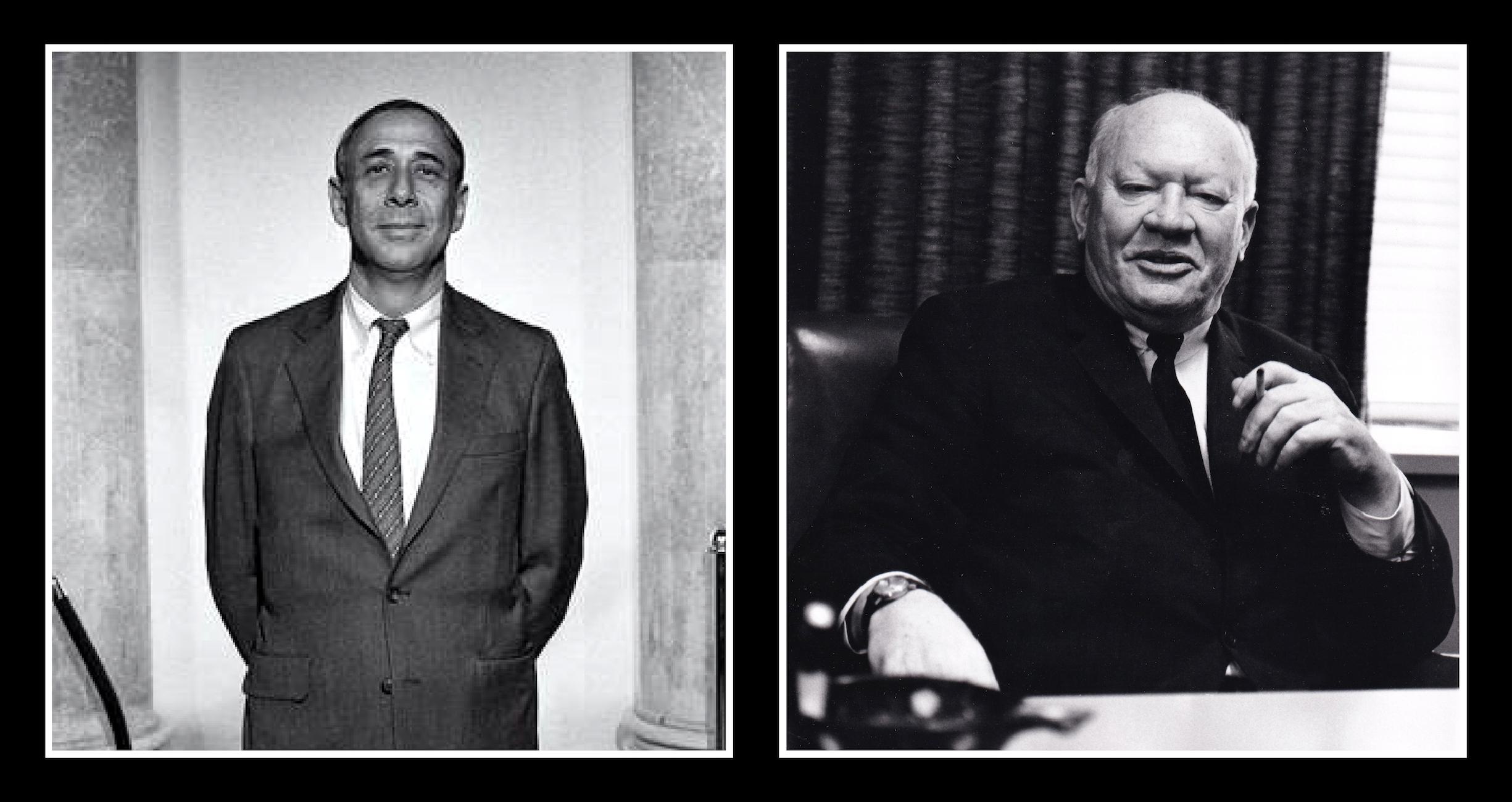
As the Vera Institute of Justice celebrates its 65th anniversary, we recall the dinner party conversation about money bail that shocked philanthropist Louis Schweitzer and set him on the path to founding this organization. Dismayed to learn how many people languished in New York City’s notorious Tombs jail simply because they were too poor to buy their freedom, he recruited magazine editor Herb Sturz to help him investigate bail policies and alternatives. The excerpt below, from the archives of Marion Katzive, was written by Sturz in 1970 and is his account of their early efforts, which led to the founding in 1961 of what was then called the Vera Foundation. Their work to transform criminal justice and immigration systems continues today in New York City and beyond.
It was at a dinner party that Louis Schweitzer heard what happens to accused persons who are too poor to buy the bail bond generally required as a condition of pretrial release. Those persons fortunate enough to be able to purchase such a bond or to post cash security are free to return to their homes and their jobs. Those who do not possess sufficient funds are remanded to jail where they sometimes remain for weeks or months pending trial.
Schweitzer was shocked by what he heard and frankly not very ready to believe it. His reaction may seem naïve when you consider that bail is known to have been in existence at least since Babylonian times, is discussed by Plato and Shakespeare, and has been a feature of the Anglo-American system of criminal justice since its inception. Nevertheless, Schweitzer had not known how the bail system works; the same can probably be said for a number of Americans.
Yet Schweitzer had a history of deep concern with individual liberties particularly as embodied in the Bill of Rights.
“What about the Eighth Amendment?” he demanded. “It guarantees that excessive bail shall not be required.”
In Schweitzer’s view if a man couldn’t raise $10, then $10 was excessive bail. (Justice William O. Douglas made this point in Bandy v. United States 81 SCT 1960.)
And when Schweitzer learned that some people spend well over a year behind bars while awaiting trial he couldn’t square this with the speedy trial provision of the Sixth Amendment.
Up to this point Schweitzer’s main concern had been with the First Amendment, perhaps since it had served as a battleground since its incorporation into the Constitution and had been under siege during the McCarthy era. He now realized that people deprived of their bodily freedom vis-à-vis the arrayed strength of the state are scarcely in a position to exercise such “niceties” as freedom of speech and assembly.
And what of the presumption of innocence?
Schweitzer’s strength at this point was compounded of overriding conviction and little knowledge; in other words, he was free of the paralysis which sometimes afflicts those well versed in the complexities of the criminal process. The skilled practitioner knows that the system is impervious to change. Mr. Schweitzer did not. Armed in glorious ignorance he set out to remedy this injustice.
[…]
Soon after the dinner party at which bail had been discussed, Schweitzer asked if I would be interested in visiting the Manhattan [House of Detention], known as the Tombs, and the Brooklyn House of Detention for young men between the ages of 16 and 20. It happened that I too was involved in problems of American justice and had recently prepared an illustrated version of the Bill of Rights which the [United States Information Agency] had translated into Vietnamese, Chinese, and Arabic, among other languages. I accepted Schweitzer’s invitation.
At the Tombs we had our first glimpse of the conditions which we later learned were nationwide—the bleak atmosphere, the smell of unwashed bodies. . . . [People] were jammed into tiny cubicles. Men merely accused of crimes were held with those awaiting sentencing. The first offender and the hardened criminal shared common cell blocks. Detention jails, we were to learn, are invariably worse than prisons. Since they are considered temporary abodes, no money is spent on rehabilitation and little on recreation. The inhabitants of this dreary institution were not permitted to phone a relative, friend, or bondsman. One phone call was made for each [person] by a correction officer who transmitted a message jotted down by the [detained person] on a slip of paper but whose report back . . . was limited to the words, “Message delivered.” If the [detained person] did not speak English, even this meager service was generally not available to him.
There were all those men behind bars and the charges against them had not been tried. [...] Most were poor. Ironically, most judges, prosecutors, and defense attorneys did not regard pretrial incarceration as a punishment.
[…]
Walking down a long corridor, we came upon thirty or forty [detained people] on their way to their day in court. A warden who had been extraordinarily courteous to us, and sympathetic with the purpose of our visit, shouted to the stragglers, “Get to the right!” His changed aspect and the way the [people] slunk against the wall made it clear that whatever their status in law, those who had not managed to bail themselves out were, in fact, deprived of the kind of respect which the layman associates with a presumption of innocence.
[…]
We began to explore the literature about bail and to realize that there already existed a strong case against the system.
[…]
We were also talking with people directly involved in the administration of bail. We queried prosecutors, defense attorneys, judges, and bondsmen about their roles in the system, whether they were in favor of changing it, and if so, how and by what means. Most informants were of the opinion that if the system were susceptible to reform, changes would have been made long ago.
We had to admit that the stability of the system was impressive. Early references to bail in English legal history suggest medieval origins and the first English statute to regulate bail administration goes back to 1275. […] Seven hundred years of history does contribute to an aura of immutability.
However, we had a hunch that tradition would fall before facts and concrete proposals. Schweitzer was willing to finance a bail reform venture; I was prepared to devote full time to the effort.
Having identified our problem, all that remained was to solve it.
At the time there was no public or private agency able to commit its resources to bail reform. Therefore, Schweitzer decided to establish a foundation for the purpose.
What should it be called?
[…]
“Maybe we should call the foundation after my mother,” Schweitzer suggested. It seemed like a good idea, though had his mother been named Clementine, Liza-Jane, or Sylvia our new baby might never had got out of its swaddling clothes. But the name Vera, beyond its private associations and connotations of truth and faith, was succinct and provocative. Vera gave us a foundation capable of being personified.