
“People Want Safety, They Want Accountability, and They Want Justice.”
Vera’s Chief Advocacy Officer, Ellen Flenniken, explains why being serious about public safety requires moving beyond failed “tough-on-crime” policies.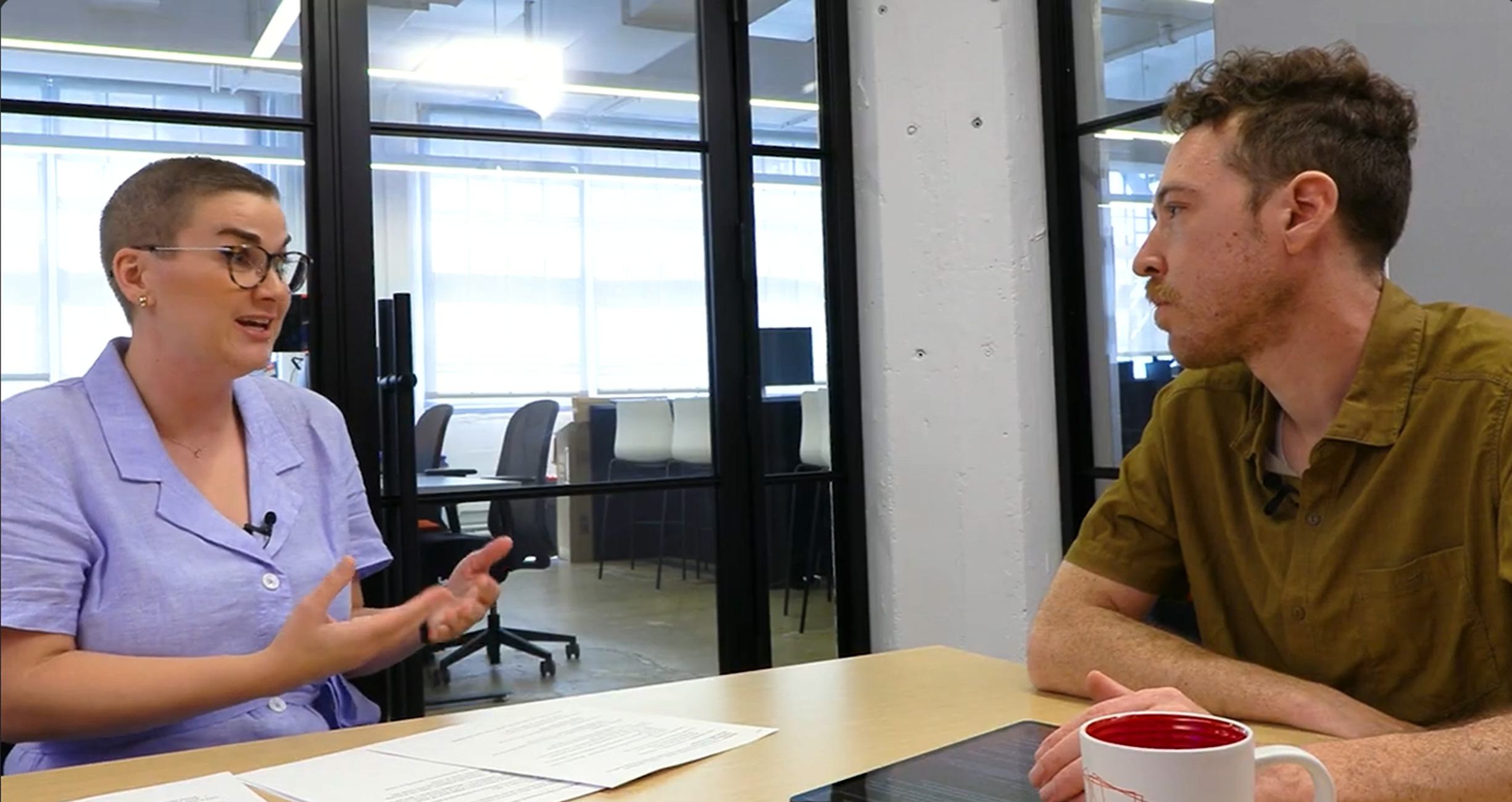
Public safety is rarely measured by crime statistics alone: it is defined by how people actually feel about their communities and the country as a whole. To address public concerns effectively, we must first understand how perceptions—and misperceptions—of crime are formed. Vera’s Chief Advocacy Officer Ellen Flenniken and Senior Writer Alex Pareene recently had a conversation about the narrative surrounding public safety, exploring how views on crime are shaped—and what it actually means to be “serious about safety.”
What follows is an excerpt of that discussion. The full video interview can be found here.
Alex Pareene: Why does Vera poll the public on crime and safety?
Ellen Flennikin:
We saw, in the 2010s, this incredible decade of progress on bipartisan criminal justice reform. Then around 2022, with crime rising largely because of the pandemic, really severe backlash to the racial justice movement. What we found was that policymakers and politicians were reverting back to these old “tough-on-crime” talking points and policies that had failed. We had to find a way to navigate these headwinds really effectively. We decided, let’s go and talk to voters, understand what they really want, not just what politicians and conventional wisdom say that they want, to try to help policymakers chart a path forward.
Vera has now conducted almost 40 rounds of polling. We have focused in particular on battleground states—understanding, in the most politically contentious terrain, how are people thinking about these issues of crime and public safety?
One of the earliest findings was that a “serious-about-safety” message that focused on preventing crime and breaking its cycle—investing in things like good schools and affordable housing, mental health and addiction services, stopping violence before it happens, getting illegal guns off the street—those are the approaches that most people across the country support. We found that people want safety, they want accountability, and they want justice.
This finding wasn’t surprising to us in the justice field. We know this. But it really is this seismic political discovery, because candidates, politicians, [and] consultants think tough on crime wins every time. What we found is that’s just not the case.
AP: What do we mean by a “serious-about-safety” agenda?
EF: Serious about safety is really just a combination of the evidence about what works and polling about how we talk about that. We take the proven solutions that we know create safety in communities, and we find a way to communicate that . . . [in a way] that voters understand. What we see in polling time after time is that they support these approaches that are safety solutions–oriented.
AP: It’s kind of a way to talk about these issues that is an alternative to the old framing where you’re either tough on crime, or you’re not tough on crime.
EF: Yes. A great example here is crisis response. We know that police are not trained as social workers or mental health counselors. And they will tell you that themselves. They do not want to be responding to 911 calls about a mental health or addiction crisis. That should not be a police call. The right response is civilian responders who have been trained in how to handle these incidents. What we’ve seen through the evidence of cities that have actually created these crisis response programs is that they see improvements in outcomes and reductions in cost. And when we poll on crisis response, voters across the political spectrum overwhelmingly support it as a solution. They understand that sending the right responder to the right call makes sense.
AP: Digging into some of the things we found in polling that I find really interesting: crime is a real problem that people have genuine concerns about that need to be addressed. But the way people think about crime can differ when they think about crime where they live, versus when they think about crime nationally.
EF: Like politics, safety is local, and people know what their own communities need. People understand that good schools and more housing and police who they can trust make their communities safer. But then when we look nationally, perceptions of safety are a completely different story. The reality is that people’s understanding of safety nationally is shaped not by their own experience but by what the media and politicians are saying about safety. And so that means that it gets distorted, particularly when you’ve got the media that are focusing on these individual incidents of crime rather than the fuller picture. The way that that plays out, interestingly, is that you see folks in big cities actually say that the country is safer than people in suburban or rural communities.
AP: Really interesting. You wouldn’t expect that necessarily.
EF: Right. The thing that we found is that it’s because people in big cities actually understand what their communities look like. They experience them every single day. So they’re not understanding safety in big cities through these distortions that the media and politicians are driving. They’re actually living it every single day.
These perceptions of “what does safety look like in my own backyard,” particularly if I live in a rural or suburban place, are very different than perceptions of crime nationally and safety nationally, where the media is telling a story that is distorted. If you’re just listening to the nightly news, you may not actually know that we are experiencing this historically significant decrease in crime.
But arguing with people about statistics is not an effective approach. What’s much more effective is to meet people where they are—to actually listen to their concerns without dismissing them, and then to present this comprehensive vision for how to create safety in communities and what steps we will actually take to get there.
This is because safety is something that people feel. Whether they are hearing gunshots in their neighborhood, or they’re hearing these crime stories on the news, it is a feeling. So trying to argue with them about statistics, and to tell them that we are experiencing this great crime decline, that is not effective. People don’t want to be told that what they’re feeling isn’t valid. They do want us to tell them: “Here are the solutions that actually create safety in communities.”
AP: It seems like sometimes crime, in the public debate, can be treated as a political issue rather than a policy issue.
EF: That happens all the time. We see politics get in the way of good governance and good safety solutions. This is actually happening right now, as we speak, where the Trump administration is actually wielding safety as this bargaining chip. They have conditioned federal dollars on cities cooperating with their mass deportation agenda. So these federal grants for local law enforcement, for community violence intervention programs, they have said you are only going to get these dollars, city governments across the country, if you share immigration data with us and you cooperate with ICE [Immigration and Customs Enforcement]. Rather than actually valuing and prioritizing the safety of millions of Americans, the Trump administration is instead using safety as this political bargaining chip. That is an abuse of power, and it’s one that’s harming all of us.
We also see that when local law enforcement does collaborate with the federal government, that actually erodes public trust in law enforcement. It reduces people’s ability to reach out to law enforcement to ask for help. So that itself, that cooperation between local law enforcement and the federal government on deportation, actually makes us less safe too.
AP: When we talk about this gap between public opinion and how politicians treat public safety issues, it’s out of fear that if they try anything other than being tough, they will be punished electorally. But in some of these cities, that hasn’t actually happened, right?
EF: Look, we are working against decades of conventional political wisdom that tough on crime wins. This is not something that we’re going to be able to undo in a single election cycle, or even frankly a decade. This is a generational struggle. It’s something that we’re going to have to continue working at.
AP: What gives you hope actually that the conversation can change?
EF: This is a generational struggle, and the forces that we are up against are so powerful and the stakes are enormous. So it’s understandable that sometimes it could feel overwhelming and discouraging. But what we know is that decades and generations of organizers and advocates have continued this valiant fight toward justice. And despite the long odds, they win and win and win. I have seen this in my own career. Early on I worked on marriage equality, and then marijuana legalization, and commuting the federal death row. Every single time, the outcome was not inevitable. We did not know that we were going to win. But what we knew was that we were fighting for justice and we needed to put one foot in front of the other every single day and work toward change. That’s what I feel here at Vera. Our mission is really bold and audacious: ending the mass incarceration of people of color and immigrants and people experiencing poverty. That is not something that we’re going to be able to transform overnight. But what I know is that through our strategic and thoughtful and unrelenting advocacy, we can transform the political reality of these issues. I feel that deeply. I work with people who feel that deeply and that’s what gives me hope every single day.