
The Immigration Laws That Built the Machinery for Trump’s Mass Deportations Turn 30
The 1996 immigration laws IIRIRA and AEDPA continue to fuel mass detention and deportation—Congress must reverse their harmful legacy.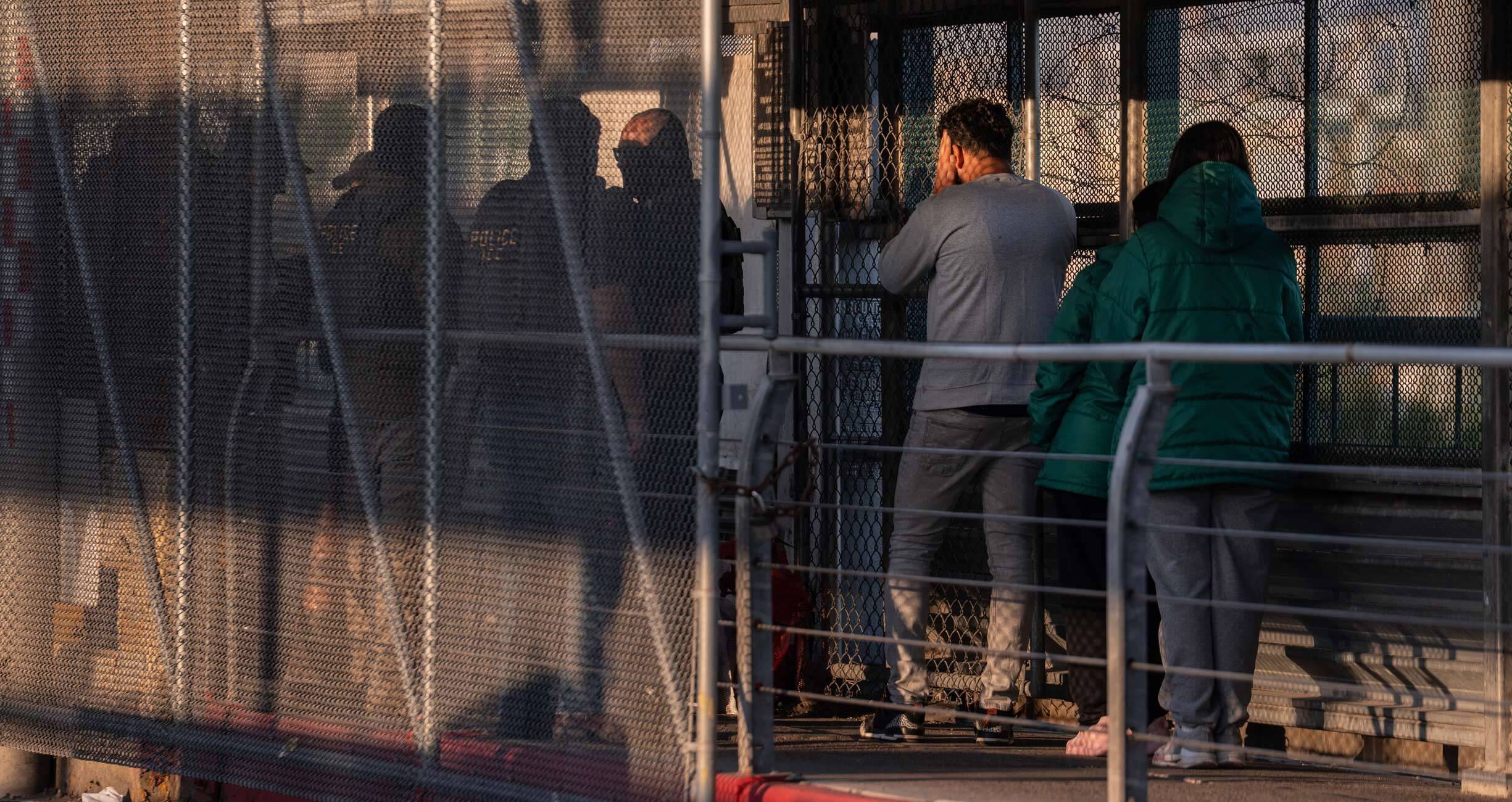
Thirty years ago, President Bill CIinton signed the Illegal Immigration Reform and Immigrant Responsibility Act of 1996 (IIRIRA) and the Antiterrorism and Effective Death Penalty Act of 1996 (AEDPA) into law, creating legal tools that have allowed President Donald Trump’s administration to quickly implement its agenda of mass detention and deportation. Together, these laws immediately increased the number of people who were subject to deportation and detention and vastly expanded the overlap between the criminal and immigration systems. Over time, IIRIRA and AEDPA built the foundation for the immigration system the United States has today—one that strips immigrants of due process, criminalizes them, and continues to expand detention.
Supercharged by two rounds of federal reconciliation funding in which Congress bypassed the annual appropriations process to award a total of $240 billion for immigration enforcement, U.S. Immigration and Customs Enforcement (ICE) and Customs and Border Protection (CBP) have more money than ever, magnifying the harms of the 1996 laws to devastating effect. Worse yet, lawmakers continue their attempts to double down on IIRIRA’s approach by introducing a slate of bills that would further gut due process and impose severe consequences in people’s immigration cases. If we are to build an immigration system that prioritizes human dignity and due process over humiliation and punishment, we must first understand the policies that laid the groundwork for the Trump administration’s agenda today.
Expedited removal: How the Trump administration is bypassing immigration due process
In its efforts to deport as many people as quickly as possible, the Trump administration has relied heavily on expedited removal, a fast-tracked deportation mechanism created by IIRIRA that bypasses typical immigration proceedings. People placed in this category do not get a hearing with a judge. Instead, immigration officers decide if a person’s detention and deportation are lawful. Past administrations primarily applied expedited removal for people who were encountered by immigration enforcement within 100 miles of a U.S. land border and who had been in the country for less than two weeks. But the first and second Trump administrations expanded the use of expedited removal nationwide and increased the time threshold to two years.
People placed into expedited removal are often deported within a single day, making it virtually impossible to consult with an attorney or gather evidence. Trump’s expansion of expedited removal has been challenged by advocates in court who have raised due process concerns, but the U.S. Court of Appeals for the District of Columbia Circuit recently sided with the administration, citing IIRIRA more than 20 times in its decision.
Mandatory detention: Depriving people of liberty without due process
IIRIRA didn’t just make deporting people easier. It also made the act of detaining people without bond hearings—called mandatory detention—commonplace. A bond hearing gives people the chance to be released while their immigration case proceeds, which in turn enables them to prepare for hearings, meet with a lawyer, and remain in their community while they wait for their time in court. IIRIRA vastly expanded mandatory detention by requiring the detention of noncitizens who are “applicants for admission” into the country. This practice has largely meant that asylum seekers presenting themselves to immigration officers at the border or ports of entry have been placed in mandatory detention with no opportunity to see a judge to request release on bond.
In July 2025, the Department of Homeland Security issued a memo stating that it would now consider anyone who entered the country without inspection as an “applicant for admission,” effectively ending bond hearings for many undocumented people, regardless of how long they have been living in the country. In response, attorneys filed tens of thousands of habeas corpus petitions in federal court to challenge their clients’ detention. This year, by early August, more than 11,800 people had been released from detention as a result of a federal court order, nearly 10 times the number during the same period in 2025. Nine federal appeals courts have rejected the administration’s mandatory detention policy, resulting in a circuit court split on the issue that could prompt U.S. Supreme Court review. In the meantime, some undocumented immigrants are being granted bond hearings while others are not, depending on which circuit court has jurisdiction over their cases.
The Trump administration did not need the Supreme Court, however, to expand mandatory detention. In January 2025, President Trump signed the Laken Riley Act, a bipartisan law that broadened the criteria for mandatory detention. For the first time, the law empowers ICE to detain people without bond hearings based on arrests, charges, or even allegations involving certain theft-related crimes, without requiring a conviction. The Laken Riley Act builds on the framework established by IIRIRA and AEDPA, further tying immigration detention to the criminal justice system.
The myth of immigrant criminality and its harms
Falsely connecting immigrants with crime has roots in the country’s early racial exclusion laws, and this harmful narrative continues to drive policies that entangle the immigration system with the criminal justice system. Congress created the “aggravated felony” category for immigration law purposes through the Anti–Drug Abuse Act of 1988 to cover three offenses: murder, drug trafficking, and firearm trafficking. Congress has since added other offenses to the list, but the most substantial changes were implemented through AEDPA and IIRIRA in 1996. These laws widened the category considerably to add nonviolent offenses—and even some crimes classified by states as misdemeanors. The term is thus misleading: an offense need not be aggravated or classified as a felony under state law to trigger serious immigration consequences.
People deemed to have committed an aggravated felony under these immigration laws are not only subject to mandatory detention but also, in some cases, expedited removal and a lifetime ban on legally returning to the United States if deported. These severe immigration consequences further compound the disproportionately harmful outcomes for Black and Latino immigrants that already exist in the criminal justice system due to racial bias. Compared to non-Black immigrants, for example, Black immigrants are detained for longer periods, are more likely to be placed in solitary confinement, and are subject to higher rates of violence and abuse in detention.
How mandatory detention fueled the system’s growth
Over the course of 30 years, the expansion of mandatory detention has fueled enormous growth in the immigration detention system—a trend that began before the Trump administration and reached its peak during President Trump’s second term. For nearly two decades before 1996, the average daily population in immigration detention was well below 10,000 people. But detention populations increased dramatically after the 1996 immigration laws were passed. Today, the detention population is seven times what it was in 1996, reaching a historic peak in January 2026 of nearly 72,000 people detained daily. (See chart, below.)

Average daily populations for fiscal years (FY) 2025 and 2026 reflect partial fiscal years, with FY2025 covering October 1, 2024, through September 20, 2025, and FY2026 covering October 1, 2025, through July 11, 2026. Average daily populations for FY1979–1993 calculated by https://github.com/themarshallproject/dhs_immigration_detention from “detention-day” statistics reported by U.S. Immigration and Naturalization Service (INS) to Congress. For FY1994–2000, see Alison Siskin, Immigration-Related Detention: Current Legislative Issues (Washington, DC: Congressional Research Service, 2004), https://tracreports.org/tracfed/tracker/dynadata/2005_12/RL32369.pdf. For FY2001–FY2014, see U.S. Immigration and Customs Enforcement (ICE), Weekly Departures and Detention Report (Washington, DC: ICE, 2016), https://oversight.house.gov/wp-content/uploads/2016/07/ICE-Weekly-Departures-and-Detention-Report1.pdf. For FY2015–FY2020, see U.S. Department of Homeland Security (DHS), U.S. Immigration and Customs Enforcement Budget Overview: Fiscal Year 2020 (Washington, DC: DHS, 2019), https://www.dhs.gov/sites/default/files/publications/19_0318_MGMT_CBJ-Immigration-Customs-Enforcement_0.pdf. For FY2019–FY2023, see DHS, U.S. Immigration and Customs Enforcement Budget Overview: Fiscal Year 2025 (Washington, DC: DHS, 2024), https://www.dhs.gov/sites/default/files/2024-04/2024_0308_us_immigration_and_customs_enforcement.pdf. For FY2024–FY2026, see ICE Fiscal Year-End Reports and most recent Fiscal-Year-to-Date Report, https://www.ice.gov/detain/detention-management.
The combined budget for ICE and CBP, which skyrocketed from $9.2 billion in fiscal year 2003 to $51.4 billion in fiscal year 2026, including annualized reconciliation funds, was also critical in this detention boom. Together, punitive immigration laws, enforcement policies, and mounting federal investments have driven an artificial demand for detention while expanding a system in which private prisons profit from detaining immigrants.
How 287(g) agreements extend ICE’s reach into local policing
The surge in federal funding is also fueling the growth of 287(g) agreements, a key component of the Trump administration’s mass deportation agenda. Created under IIRIRA, 287(g) agreements allow ICE to deputize state and local law enforcement officers to perform a range of federal immigration functions, including arresting and detaining immigrants. From January 2025 to September 2026, the number of 287(g) agreements grew from 135 to 2,597, as of September 30. As the program’s reach widened, the share of the U.S. population living in a county with a participating law enforcement agency reached 32 percent.
The program undermines public safety by eroding trust between communities and local law enforcement. When contact with police can lead to detention and deportation, immigrants and their families are less likely to call emergency services, report crimes, or participate in routine activities like driving to work, seeking health care, and going to school.
287(g) agreements have also been shown to result in widespread racial profiling, disproportionately impacting Latino and Black communities. For example, an investigation into Maricopa County’s 287(g) program found that Latino drivers were up to nine times more likely to be stopped for traffic violations than non-Latino drivers. While some states, like New York and New Mexico, have recently joined other jurisdictions in banning 287(g) agreements, other states, like Florida and Tennessee, require some of their law enforcement agencies to participate.
Congress must reverse IIRIRA and AEDPA’s harmful legacy
During Trump’s second term, the American public has witnessed the violent and destabilizing impacts of an immigration enforcement system that was built 30 years ago based on damaging narratives that equate immigrants with criminality. These policies have resulted in an overly punitive immigration system that restricts access to due process and does not advance public safety.
Lawmakers must take action to reverse course on these policies by supporting legislation that:
- reduces detention overall and eliminates mandatory detention;
- rolls back laws that contribute to racial profiling, mass detention, and deportation; and
- ensures access to counsel for people facing deportation.
They must also reject the false criminalizing narratives and policy proposals that seek to expand on IIRIRA's harmful approach. Understanding how these policies created today’s punitive system is essential to changing course, protecting due process and human dignity, and preventing further harm—regardless of who is in the White House.