
Prison Heat Crisis Grows as Global Temperatures Increase
As temperatures rise, thousands of incarcerated people face dangerous—even deadly—heat in prisons that still lack air-conditioning.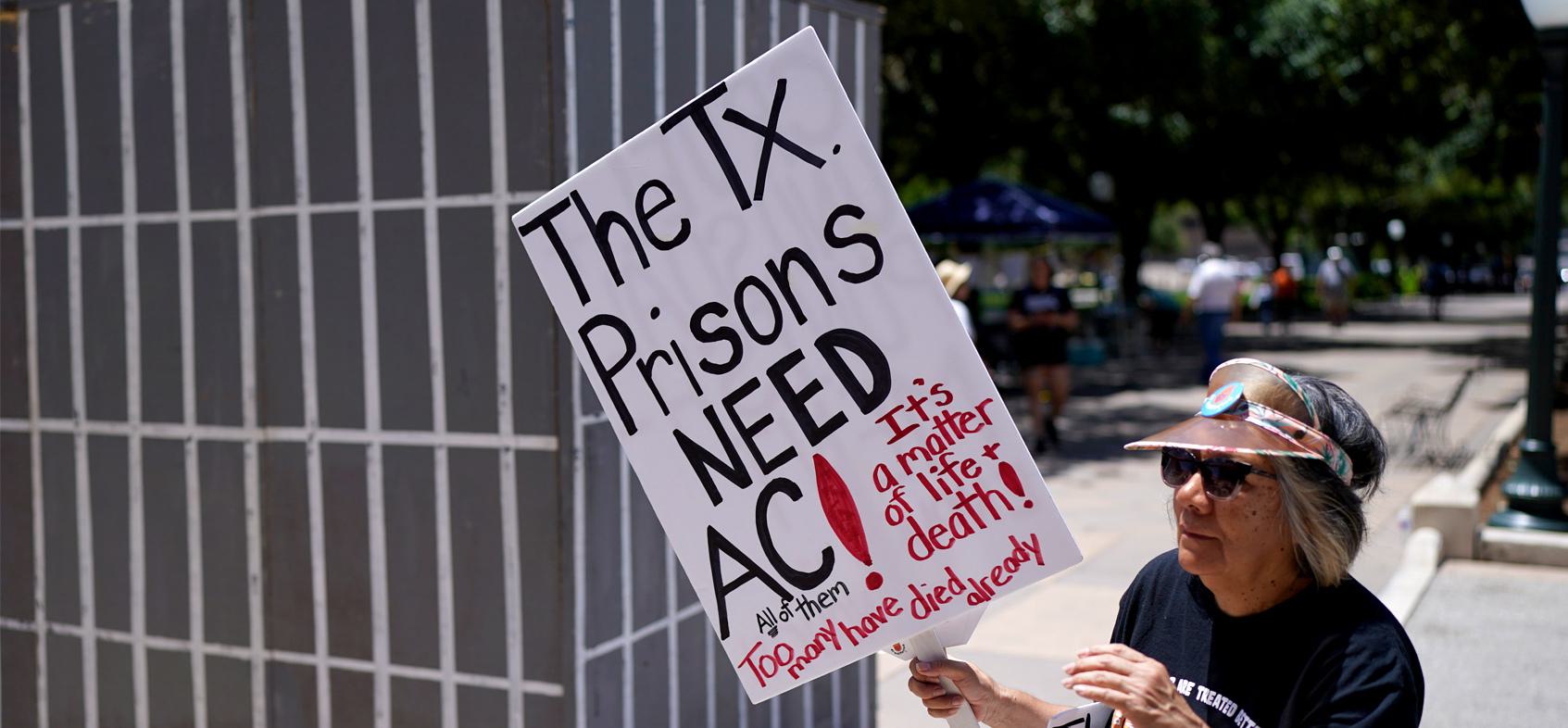
A group of organizations has sued the Texas Department of Criminal Justice (TDCJ), arguing that confining people in sweltering conditions violates the constitutional ban on cruel and unusual punishment. This trial began in federal court in early April and has given some hope to incarcerated people and their advocates, who are asking the judge to force the state of Texas to finally air-condition its prisons.
Texas incarcerates more people per capita than any other state, and the majority of Texas jails and prisons are not air-conditioned. Research shows that air-conditioning would help protect the health of incarcerated people. Advocates, attorneys, and incarcerated people have fought for heat relief in prison for decades.
After a long day of prison farm labor under the scorching Texas summer sun, Marci Marie Simmons would return to her cell, which would be hotter than outside. “You would have to mentally prepare yourself knowing that you were going back into that dorm,” Simmons, who spent years incarcerated in a prison without air-conditioning, told NPR. “I remember laying on my bunk, wondering if I would survive.”
Many incarcerated people don’t survive intense summer heat. During a 2023 heat wave, at least 41 incarcerated people died in Texas prisons, where heat readings in state prisons regularly read 100 degrees or higher. Summer has long been a season of intense suffering for people incarcerated in Southern states in prisons without air-conditioning. This will only worsen as global temperatures increase. As a result of climate change, even more Northern prisons are already experiencing extreme heat.
Lance Lowry, the former head of the Correctional Officers Union, is quoted in the new lawsuit as saying, “We’re not trying to make this lush, we’re trying to make it humane. . . . These are institutions for incarceration. The incarceration is their punishment. Not cooking them to death.”
Khaȧliq Shakur, who has spent more than 20 Texas summers behind bars, wrote that being trapped in a cell in a hot prison indeed feels like being cooked. “Almost everybody has visited a fast-food restaurant or roadside gas station at some point in their lives. Can you picture the rotisserie chickens, slowly rotating under the red-hot light? . . . After living in Texas prisons for 23 years, I think I can tell you what it feels like to be that chicken.”
In some cases, Texas spends more money fighting lawsuits over installing air-conditioning in prisons than it would cost to simply install it. For example, TDCJ estimated it would cost $4 million to install air-conditioning at the Wallace Pack Unit, located 70 miles outside of Houston, after the department spent more than $7 million fighting a lawsuit brought forward by people incarcerated at the unit.
This senseless waste is facilitated by the incorrect perception that incarcerated people deserve to be punished under torturous conditions. This notion is so pervasive that when politicians sought to convince voters in Jefferson Davis Parish, Louisiana, to fund a new jail, they touted the fact that the facility would not have air-conditioning.
As the Texas lawsuit proceeds, advocates for incarcerated people in Florida, Louisiana, and Missouri are also fighting in court for protections from extreme heat. Providing air-conditioning for safe temperatures in prisons should be seen as a necessary expense, especially as climate change exposes more people to extreme heat. “From behind these bars, I can say it feels like each year just gets hotter,” wrote Shakur. “Texas has prosecuted people before for leaving their dogs in baking cars. . . . Would you place a family member in sweltering heat as punishment for something they did?”