
On the Fifth Anniversary of Juneteenth as a National Holiday, California and Colorado Chart a Path Toward Ending Prison Slavery
Millions of incarcerated people remain trapped by the 13th Amendment’s exception clause. But recent wins in California and Colorado show how states can lead the way to ending prison slavery.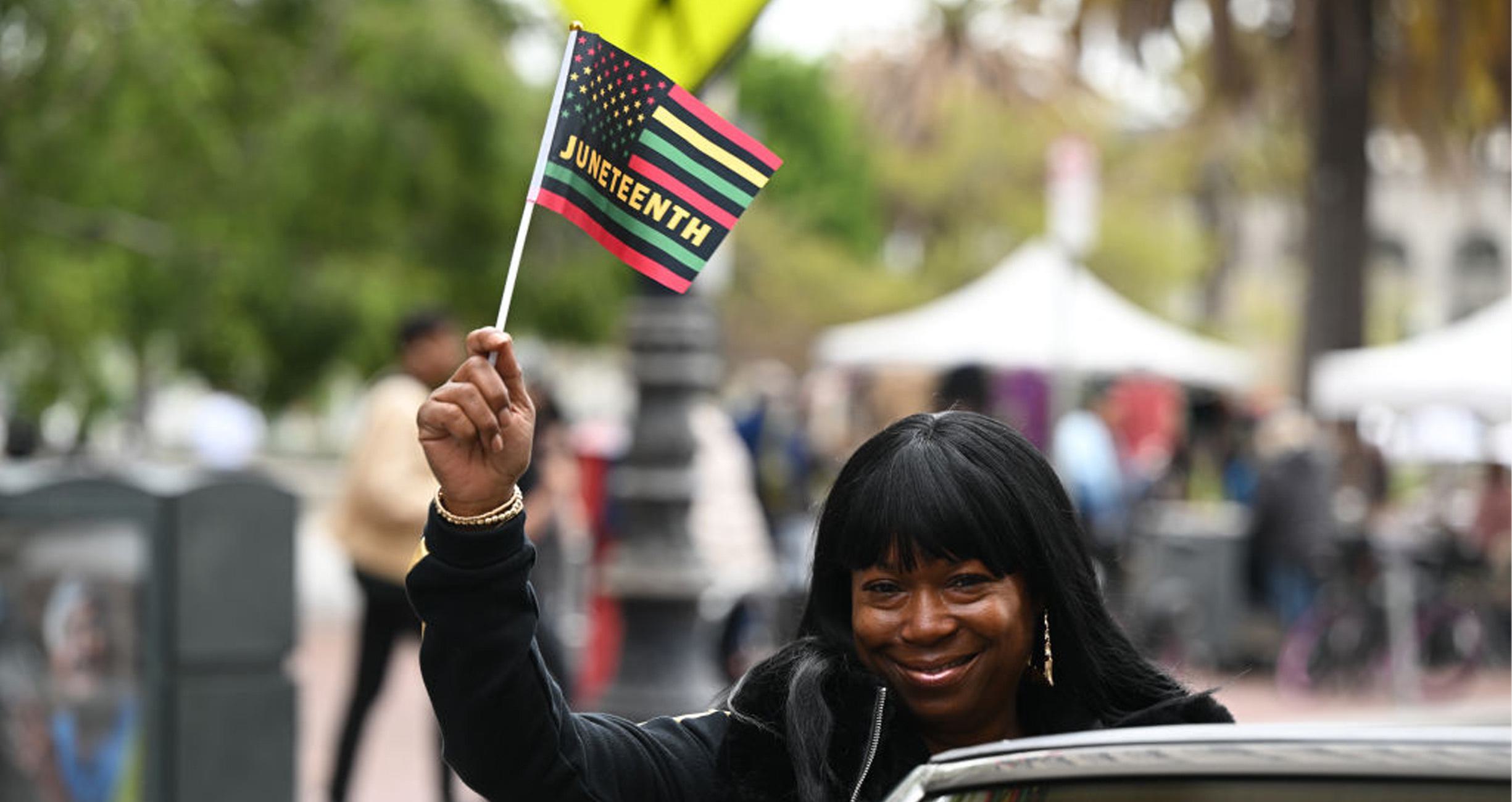
This year marks the fifth anniversary of Juneteenth becoming a federal holiday, and the 161st anniversary of the event it commemorates: General Order No. 3, which Union General Gordon Granger delivered to Galveston, Texas, on June 19, 1865, bearing the belated news that “all slaves are free” following the January 1863 Emancipation Proclamation. By the close of 1865, the 13th Amendment was added to the United States Constitution, which would, according to the Radical Republican Senator Henry Wilson, “make impossible forevermore the reappearing of the discarded slave system, and the returning of the despotism of the slavemasters’ domination.” Yet even today, the country is still working to deliver on the promise of freedom made to those Galveston residents.
There was one large exception in the otherwise decisive wording of the 13th Amendment to end slavery. It is this clause, forbidding slavery “except as a punishment for crime whereof the party shall have been duly convicted.” This represents the only circumstances under which the United States formally and officially still allows slavery and involuntary servitude. It has turned out to be an exception large enough to ensnare millions of people over the last 160 years.
The drafters of the amendment adopted the language almost verbatim from the 1787 Northwest Ordinance. It left an obvious path to the partial continuation of slavery for decades after the war: through Black Codes—which provided pretenses to convict scores of ostensibly free Black people, including children, of “crimes” such as “walking without a purpose” or “walking at night”—and convict leasing, which organized the forced labor of these “duly convicted” “criminals” for the benefit of Southern states and private industry.
After too many years, those practices were also abolished. But the language of the “exception clause” remains the law of the land, and the result is the modern continuation of slave labor in the United States. In sheer numbers, the scope of this modern-day slavery is staggering. According to one 2022 estimate, nearly 800,000 of the 1.2 million people in state and federal prisons are prison laborers. Most incarcerated laborers report worrying about their safety. Most, despite working, still can’t afford to purchase necessities. As one incarcerated person told the Vera Institute of Justice, “An incarcerated person would have to work a whole month to be able to afford [a bar of soap, deodorant, laundry soap, and lotion].”
Every year, these incarcerated workers produce $2 billion in goods and services. And prison labor itself subsidizes and helps sustain our incredibly expensive mass incarceration machine: one 2004 estimate values the prison maintenance and upkeep work carried out by incarcerated people at $9 billion a year.
All of this adds up to an enormous amount of labor stolen from incarcerated people—around $18 billion in stolen wages a year, according to the End the Exception campaign by the Abolish Slavery National Network, a coalition working to abolish constitutional slavery and involuntary servitude in all forms—and Black people are vastly overrepresented in the population of people being exploited.
There are efforts to reduce the overall population of people in jails and prisons, and campaigns to amend the Constitution to fix the exceptions clause, but these are long-term projects. In the shorter term, it is possible to address this modern-day slavery at the state and local levels. And there is precedent: the worst abuses of the convict leasing era were reformed state by state, beginning decades before the federal government passed a 1935 law banning the interstate transport of goods made by prison labor. Nine states currently ban slavery without exception, and most of them amended their constitutions to remove the penal exception within the last decade. (Rhode Island, the sole exception, has had a blanket ban on slavery in its constitution since 1842.)
As of this Juneteenth, there is more evidence that modern-day slavery will be defeated as surely as its predecessor was. In one significant case, California’s legendary incarcerated firefighters will finally earn minimum wage for their brave and vital work. And in Colorado, where voters elected to ban slavery without exceptions back in 2018, a judge ruled earlier this year that the use of work requirements and threats (including solitary confinement) to “incentivize” incarcerated people to work amounted to involuntary servitude, a violation of the state constitution.
For the plaintiffs and the advocates behind the constitutional push, this was a major victory. As Kym Ray, co-chair of End Slavery Colorado, put it, the ban on slavery in that state “is not a suggestion. It was a mandate from the people of Colorado.” This victory was possible because Colorado’s voters demanded, without equivocation, an end to slavery. It will, unfortunately, take a lot of time and effort to fix the 13th Amendment. In the meantime, California and Colorado represent successes to build on.